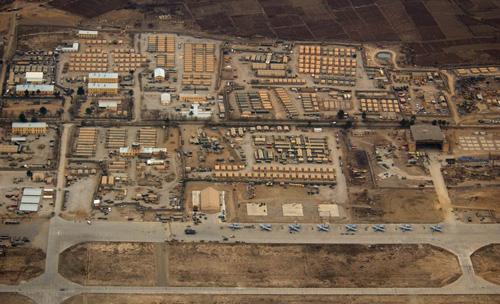
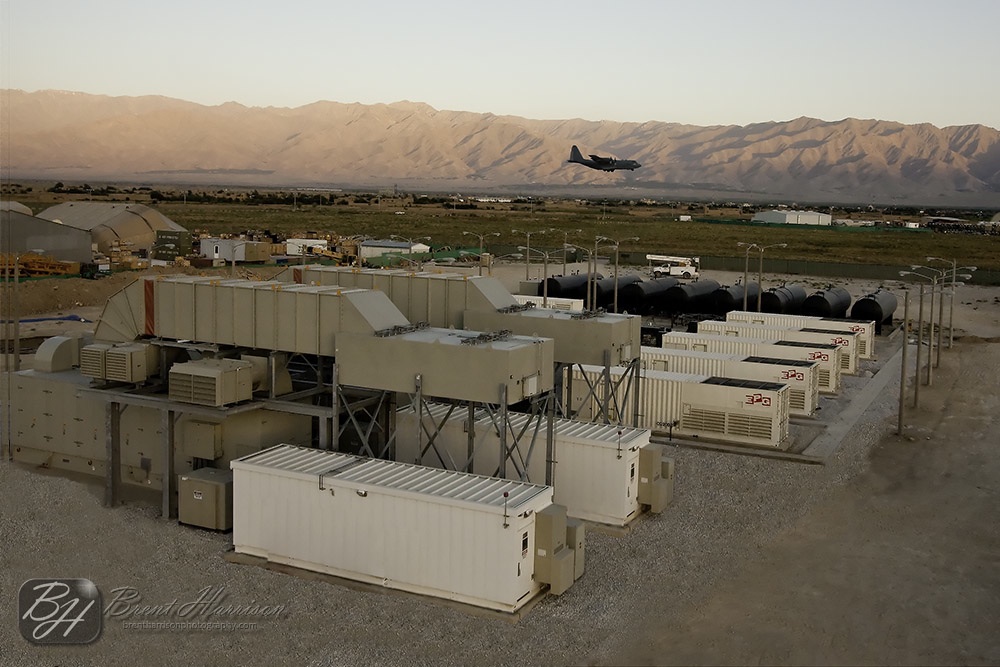
Between 2009 and 2014, Enginuity Portable Grid (EPG), in conjunction with Mid-America Engine, Inc., provided conceptual design, engineering and equipment supply for the 60MW power plant at Bagram Air Base, providing off-grid utility grade power for the entire base load, supporting the airbase and ground troop operations 24 hours a day/7 days a week/365 days a year.
The growing demand for power at this facility produced many challenges for EPG and Mid-America Engine. The U.S. military wanted a “true” utility grade solution that provided both reliability and redundancy in a central location. The challenge was to meet this demand, given the extreme weather conditions at the 4,900-foot elevation site where temperatures regularly exceed 120°F in the summer.
The final accepted proposal and concept utilized Ten EPG Model CQ-2000 2MW Power Modules, de-rated to 1400kW Each, providing 14MW of power; these units work in conjunction with Four Solar Titan T-130 Gas Turbine Generator Sets and one Taurus 70 Gas Turbine, de-rated to 46MW. As a result of the extreme temperature and elevation, the unit’s factory ratings were de-rated and work together to provide a total of 60MW of power.
The design of the power plant enabled the EPG CQ-2000 power modules to provide “black-start” capability for the Solar gas turbines as well as peak shaving at times of extreme high temperatures. The EPG power modules were digitally paralleled through the Cummins 3201 Power Command Control System to the Solar Turbines so they could provide full backup should one of the turbines be taken offline for maintenance or in case of failure. The entire power plant and fuel system were controlled and monitored through a specially designed custom SCADA system built and installed by Mid-America Engine’s Turbine Services Group. The SCADA system was designed to follow the base load demand and increase or decrease electric power generation as needed. The system also provided load shedding in the event of a failure and included the ability to log events, as well as track maintenance and total fuel burn.
The time from concept design acceptance to start up was roughly 16 months.