

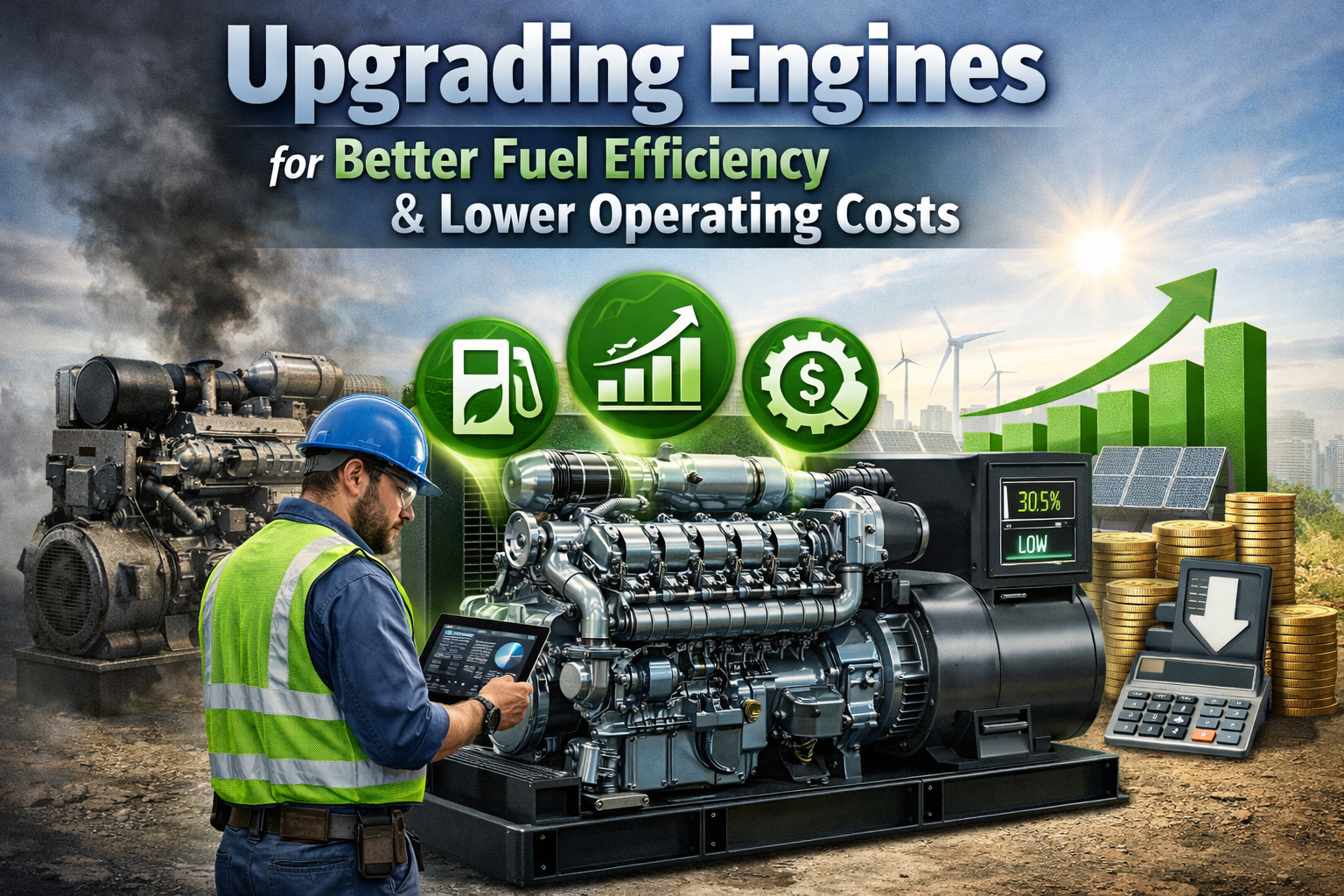
Fuel is one of the largest lifetime costs of running industrial equipment. When engines age, efficiency drops quietly through wear, outdated technology, poor combustion, and mismatched sizing. The result is higher fuel burn, rising maintenance spend, and unpredictable downtime. Upgrading or repowering an industrial engine is often the fastest way to cut operating costs without replacing the entire machine.
This guide explains when an engine upgrade makes financial sense, what actually improves fuel efficiency, and how to lower operating costs without sacrificing reliability.
Why Older Engines Become Fuel Inefficient
Engines don’t suddenly become inefficient. Losses build gradually.
Internal wear increases friction and blow-by, reducing combustion efficiency.
Outdated fuel systems lack precision compared to modern electronic injection.
Older engines often run oversized or undersized for current workloads.
Cooling and airflow degradation increases parasitic losses.
Emissions retrofits on older platforms often reduce efficiency further.
At a certain point, maintenance keeps an engine running but not running efficiently.
When an Engine Upgrade Makes Sense
An upgrade is worth evaluating when fuel costs rise faster than production output.
If fuel consumption has increased noticeably without workload changes, efficiency has declined.
If maintenance frequency and downtime are increasing, operating costs are compounding.
If the engine no longer meets emissions requirements without performance penalties.
If parts availability is declining or lead times are growing.
If equipment usage has changed since the engine was originally selected.
In many cases, upgrading the engine delivers a faster ROI than continuing to repair an aging platform.
How Modern Engines Improve Fuel Efficiency
Fuel efficiency gains come from multiple improvements working together.
Modern electronic fuel injection delivers precise fuel metering under real load conditions.
Improved combustion chamber design increases energy extraction from every gallon.
Optimized turbocharging delivers higher torque without higher fuel burn.
Smarter engine control modules adjust performance dynamically instead of running fixed maps.
Better cooling and airflow reduce wasted energy and thermal stress.
Efficiency improvements of 5–15% are common when upgrading from older-generation engines.
Repower vs Rebuild: Which Lowers Costs More?
Rebuilding restores an engine to baseline condition. Repowering improves the baseline.
A rebuild addresses wear but does not change original efficiency limits.
A repower replaces the engine with a newer, more efficient platform.
Repowers often reduce fuel use, emissions complexity, and service intervals simultaneously.
Rebuilds are cost-effective when the platform is still well-matched and supported.
If fuel cost reduction is the primary goal, repowering usually delivers stronger long-term savings.
Right-Sizing the Engine for Real-World Loads
Incorrect sizing is one of the biggest hidden efficiency killers.
Oversized engines operate at low load, wasting fuel and increasing emissions issues.
Undersized engines operate near maximum output constantly, burning more fuel per unit of work.
Right-sized engines operate in their most efficient load range during normal operation.
An upgrade is the ideal time to match engine output precisely to actual duty cycles, not outdated assumptions.
Emissions Systems and Fuel Economy
Modern emissions compliance does not have to mean lower efficiency.
Engines designed for Tier 4 Final from the ground up are more efficient than older engines retrofitted to comply.
Properly matched duty cycles reduce regeneration frequency and fuel penalties.
Newer engines integrate emissions control without sacrificing torque delivery.
Upgrading often simplifies emissions management while improving fuel economy.
Reducing Maintenance-Driven Operating Costs
Fuel is only part of operating cost reduction.
Newer engines often extend service intervals and reduce oil capacity requirements.
Improved diagnostics allow early issue detection before failures occur.
Better parts availability reduces downtime and emergency repair costs.
Cleaner combustion reduces wear on injectors, valves, and aftertreatment systems.
Lower maintenance spend compounds fuel savings over the engine’s life.
Measuring ROI the Right Way
The real question isn’t “How much does the upgrade cost?” It’s “How fast does it pay for itself?”
Calculate fuel savings based on actual hourly consumption and operating hours.
Add reduced maintenance, downtime avoidance, and compliance cost savings.
Compare against the installed cost of the upgrade or repower.
Most well-planned engine upgrades pay back within a few operating years.
Focusing on cost per operating hour provides clarity that upfront pricing never does.
Common Mistakes That Kill Efficiency Gains
Upgrades fail when planning is shallow.
Installing a more efficient engine without correcting load mismatch.
Ignoring cooling, filtration, and drivetrain integration.
Choosing technology based on trends instead of use case.
Skipping operator training on new systems.
Efficiency gains require a system-level approach, not just a new engine block.
Why Mid-America Engine Is Better for Your Business
Upgrading for efficiency only works when the engine is selected and configured correctly. Mid-America Engine specializes in helping businesses reduce fuel and operating costs through proper engine selection, repowers, and rebuild strategies.
Their team evaluates real duty cycles, fuel usage patterns, emissions requirements, and long-term cost goals before recommending an upgrade path. Whether it’s a new, rebuilt, or remanufactured engine, solutions are tailored for efficiency, reliability, and ROI.
That approach delivers measurable fuel savings, fewer breakdowns, and predictable operating costs instead of short-term fixes.
Frequently Asked Questions
How much fuel savings can an engine upgrade deliver?
Most upgrades deliver 5–15% fuel efficiency improvement, depending on engine age and application.
Is repowering better than rebuilding for fuel efficiency?
Yes. Repowering introduces newer technology that rebuilds cannot provide.
How do I know if my engine is oversized?
Consistent low-load operation, high fuel use, and emissions issues are common signs.
Do newer engines cost more to maintain?
Not usually. Many have longer service intervals and better diagnostics.
Can emissions compliance upgrades improve efficiency?
When designed into the engine, yes. Retrofits often do the opposite.
What industries benefit most from engine upgrades?
Construction, mining, agriculture, power generation, and material handling.
Will upgrading reduce downtime?
Yes, especially when parts availability and diagnostics improve.
Is operator training necessary after an upgrade?
Absolutely. Proper operation protects efficiency gains.
How long does an engine upgrade take?
Timelines vary, but most repowers are completed faster than full equipment replacement.
Who should evaluate my upgrade options?
An experienced industrial engine supplier who understands real-world operating conditions.





Leave A Comment