When a generator is undersized for a facility with large motors, the problem often isn’t the total running load. It’s the brief, demanding surge when a motor starts.
That surge can pull down generator voltage and frequency just as critical equipment is coming online. The generator may be able to carry the motor once it is running and still struggle to start it reliably, or cause other connected equipment to trip during the starting event.
The right sizing process accounts for both steady-state demand and transient performance. It considers motor data, starting method, load sequence, and the voltage and frequency limits of the equipment the generator must protect.
Running load and starting load are different
Running load is the electrical demand once equipment is operating steadily. Starting load is the momentary demand required to accelerate a motor and its driven equipment from rest.
An induction motor can draw roughly six to eight times its full-load current at startup, though actual locked-rotor amps (LRA) vary by motor. The surge may last a fraction of a second or several seconds, depending on motor size, starting method, mechanical load, and how quickly the motor accelerates.
This is why adding up motor horsepower or running kW alone is not enough. During startup, the generator must supply the motor’s inrush without allowing voltage or frequency to fall far enough to stall the motor, drop out a contactor, or disrupt other equipment.
For a three-phase motor, starting kVA can be estimated from its locked-rotor current and voltage:
Starting kVA ≈ √3 × voltage × locked-rotor amps ÷ 1,000
That calculation helps describe the demand, but it doesn’t by itself determine the right generator. Alternator design, excitation system, engine response, wiring, motor acceleration, and other loads affect how the system performs. Use nameplate or manufacturer motor data wherever possible, not a generic multiplier when better information is available.
Starting method changes the demand
The way a motor starts has a direct impact on the generator’s required starting capability. Common methods include:
- Across-the-line (direct-on-line): Applies full voltage immediately. It provides strong starting torque but also produces the highest inrush and can create a substantial voltage dip.
- Wye-delta: Starts the motor in a lower-current configuration before switching to its normal running configuration. Starting current is reduced, but so is starting torque. The motor still needs enough torque to accelerate its load, and the transition between configurations should be evaluated.
- Soft starter: Ramps voltage to limit current and torque during startup. Settings must allow enough torque to accelerate the connected equipment within an acceptable time.
- Variable frequency drive (VFD): Ramps motor frequency and voltage, usually providing controlled acceleration and reducing the starting demand seen by the generator. The complete drive system still needs review, including input characteristics, harmonics, bypass operation, and ride-through behavior.
Reducing inrush can make a generator application more manageable, but it is not a shortcut around engineering. Lower starting current can also mean lower torque. If a pump, compressor, or other load cannot accelerate properly, a gentler start may simply extend the problem.
A motor can start and still cause trouble
A successful start does not necessarily mean the generator is correctly sized. Voltage and frequency can dip far enough to affect other equipment, even if the motor eventually reaches speed.
A voltage dip may cause contactors to drop out, control systems to reset, or sensitive electronics to malfunction. Motor torque also falls as voltage falls, which can slow acceleration and keep the motor drawing high current for longer. Frequency dip reflects the generator engine’s response to the sudden load and can affect equipment designed to operate within a defined frequency range.
There is no single acceptable dip limit for every facility. Motors, UPS systems, controls, and other connected equipment have different tolerances. The design needs to consider the whole power system: what is already running, what starts next, and what connected equipment can tolerate during the event.
Review the equipment specifications and the generator manufacturer’s transient data. Generator-sizing tools and a manufacturer’s transient-performance analysis help evaluate voltage dip, frequency response, motor acceleration, and recovery. A generator that starts the motor but disrupts the process around it is not the right solution.
Sequence the loads to control the largest step
Starting several large loads at once can require considerably more generator capability than starting them in stages. A facility may have a substantial combined motor load but avoid the worst-case simultaneous inrush by using a defined sequence.
For example, a control scheme can start one motor, allow voltage and frequency to recover, and then start the next. Automatic load sequencing or load shedding can prioritize critical equipment and limit the size of each load step.
Common motor-starting loads include:
- Air conditioners and data center cooling equipment
- Chillers and pumps
- Air compressors
- Elevators
- Fire pumps
A generator sizing review should examine the actual sequence of operation, not just a list of connected loads. Identify which equipment starts together, what is already online at each step, and how long the system has to recover before the next load is applied.
Diesel and natural gas both require application-specific review
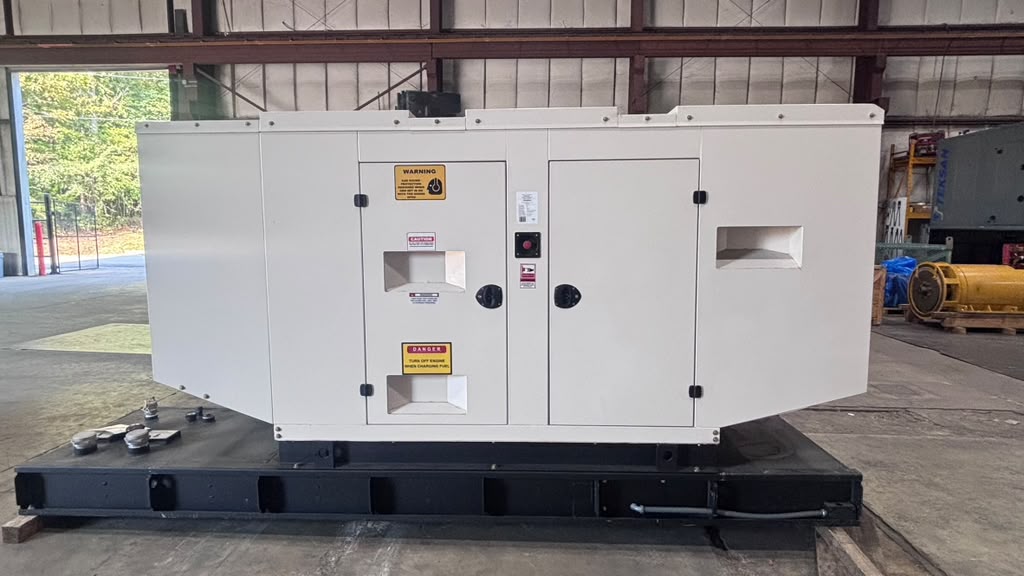
Diesel generators generally respond well to large, sudden load steps, making them a strong option for applications with demanding motor starts. Natural gas generators can also serve many motor-driven applications when properly selected and controlled, but engine response and transient performance vary by model and configuration. In some applications, the load sequence, starting method, or generator selection may need to account for that response.
Fuel type alone does not settle the sizing question. The generator, alternator, controls, load characteristics, and performance requirements all matter. Compare manufacturer transient data for the specific equipment under consideration. Do not assume that one fuel type or generator rating will perform the same across different applications.
Bring these details to a sizing review
A reliable review depends on accurate equipment and operating information. Gather:
- Motor nameplate data, including voltage, horsepower or kW, full-load amps, and LRA or locked-rotor code
- Starting method and, where applicable, starter or VFD settings
- Driven-load details, such as load type and acceleration requirements
- Sequence of operation, including which loads start together and which are already running
- Acceptable voltage and frequency limits for motors, controls, UPS systems, and sensitive equipment
- Future expansion plans that could change the load profile
With these details, engineers can assess the steady-state load and the most demanding starting event. If the proposed system does not meet the application’s requirements, the answer may involve a different generator, a different starting method, a revised sequence, or a combination of changes.
Size for the event, not just the steady state
Generator sizing for motor loads is a system-level decision. Running kW matters, but it does not describe the full challenge of bringing large motors online. Starting current, acceleration, voltage and frequency recovery, and load sequence all affect dependable operation.
For more than 40 years, Mid-America Engine has helped organizations evaluate industrial power requirements with an engineering-driven approach and honest recommendations. We offer new and used industrial generator sets, along with turnkey installation options. The right equipment depends on the application, not on a generic rule of thumb.
Contact Mid-America Engine’s team to review your motor data and operating sequence. We’ll help you identify the information needed to evaluate a dependable solution.
Frequently asked questions
Why does a motor need more power to start than it does to run?
At startup, an induction motor is stationary and can draw several times its normal full-load current. That inrush provides the force needed to accelerate the motor and connected equipment. Once the motor reaches operating speed, current typically falls toward its normal running level.
Does a soft starter or VFD mean I can use a smaller generator?
It may reduce the starting demand, but it does not automatically determine generator size. The starter or drive must provide enough torque for the load, and the full system must be checked for voltage and frequency performance, acceleration time, and any drive-related effects.
Should large motors start at the same time?
Starting large motors simultaneously can create a much larger load step than starting them in sequence. Staging starts can reduce the peak demand, but the sequence should account for the equipment already running and the time needed for the generator to recover.
Is diesel always better than natural gas for motor starting?
Not always. Diesel units generally respond well to large, sudden load steps, while properly selected and controlled natural gas units can handle many applications. Compare manufacturer transient data for the specific generator and operating conditions before making a decision.
What information should I provide for a generator sizing review?
Bring motor nameplate data, LRA or locked-rotor information, starting methods and settings, the load sequence, equipment voltage and frequency tolerances, and any planned facility expansion. Manufacturer transient data and sizing software should be used to validate the final selection.