Diesel prices are no longer a minor line in the standby-power budget. The U.S. Energy Information Administration’s weekly on-highway diesel average was $6.199 per gallon for the week of October 5, 2026. AAA’s national daily average reached $6.28 on October 8. For a facility that depends on diesel during a long outage, that price makes fuel planning an operating-cost and continuity issue.
The right response is not automatically to switch fuels. It is to understand your generator’s actual fuel burn, confirm usable on-site capacity, and account for fuel quality and delivery risk. Mid-America Engine has spent more than 40 years helping facilities make those decisions with an engineering-driven approach and honest recommendations.
Know the Cost of Each Runtime Hour
A useful first calculation is straightforward:
Gallons per hour × delivered diesel price = fuel cost per runtime hour
At $6.20–$6.28 per gallon, a 100 kW diesel genset burning about 7.4 gallons per hour at full load costs approximately $46 per hour in fuel. A 125 kW unit burning roughly 7.3–9.6 gallons per hour at full load costs about $45–$60 per hour.
Those are full-load estimates, not a forecast for every outage. Fuel consumption generally drops at partial load, and many facilities operate at roughly 60–70% of generator capacity. As a rough illustration, a 125 kW set burning around 5.8–7.1 gallons per hour at a moderate-to-high load would use approximately $36–$45 in fuel per hour at today’s prices. Actual burn depends on the engine, generator model, load profile, and operating conditions. Use the manufacturer’s fuel curve for final budgeting.
The generator’s standby and prime ratings matter, too. Standby rating is intended for emergency use during utility outages, with operating limits set by the manufacturer. Prime rating applies to variable-load operation where the generator is the primary source of power. These ratings are not interchangeable. Check the correct rating and fuel-consumption data for your application rather than sizing from the nameplate kW alone.
For a fuller comparison of fuel and operating considerations, see Mid-America Engine’s guide to industrial diesel generators versus natural gas.
Size Storage for the Outage You Need to Cover
A day tank or sub-base tank may support routine testing and shorter outages, but it may not provide the endurance a critical facility requires. A practical planning example is a 125 kW unit operating at about 75% load. Depending on the unit’s fuel curve, 72 hours of operation can require roughly 450–510 gallons.
| Planned runtime | Approximate fuel at 6.5–7.1 gal/hr |
|---|---|
| 24 hours | 156–170 gallons |
| 48 hours | 312–341 gallons |
| 72 hours | 468–511 gallons |
These are planning estimates, not code requirements or a substitute for the genset’s fuel curve. Allow for unusable tank volume, reserve, load changes, and operating conditions when calculating capacity. Confirm the required duration with your facility’s risk plan, applicable codes, and the authority having jurisdiction.
Refueling can be difficult to count on during a regional emergency. A delivery may cost more, arrive later than expected, or compete with hospitals, utilities, and other customers for limited supply. On-site storage is the dependable part of the plan; a fuel-delivery contract is a useful supplement, not a substitute.
Mid-America Engine currently lists new EPG diesel gensets as in stock, ready to ship today. Options include the EPG Model 100JD 100 kW, EPG Model 125JD 125 kW, EPG Model 125P 125 kW, and EPG Model 60P 60 kW. Check current availability and configuration with the team.
Treat Fuel Quality as Part of the System
Stored diesel needs regular attention. Depending on storage conditions and treatment, fuel can degrade over time, often within 6–12 months, and water intrusion can encourage microbial growth. Contamination and poor fuel condition can lead to clogged filters, injector problems, or unreliable starts. Cold weather also raises the risk of gelling if fuel is not suitable for expected temperatures.
A dependable maintenance plan should address the fuel as well as the engine:
- Test stored fuel at least annually, and follow the results with corrective action.
- Inspect tanks and related equipment for water, sediment, leaks, and contamination.
- Schedule fuel polishing when testing or inspections indicate it is needed.
- Use additives only when appropriate for the fuel, storage conditions, and equipment manufacturer’s guidance.
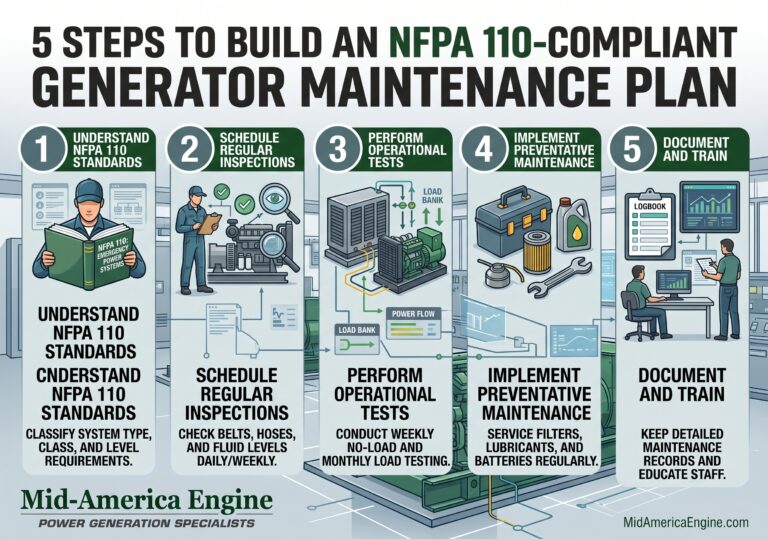
Fuel polishing and annual testing are practical safeguards, not optional extras for systems expected to carry critical loads. Include them in your generator maintenance budget alongside routine engine service and load-bank testing. See generator maintenance services and support, and browse fuel tanks, transfer switches, and other parts and accessories.
When Natural Gas May Be the Better Fit
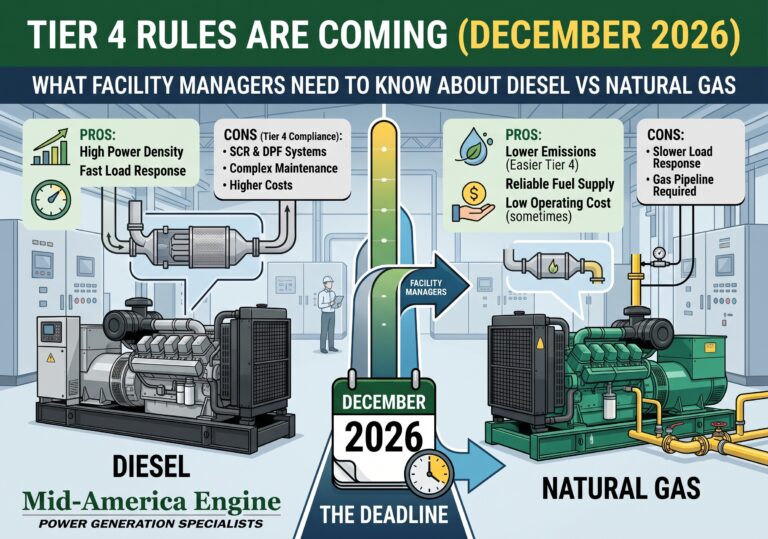
Natural gas generators avoid on-site liquid-fuel storage, fuel degradation, refueling logistics, and fuel-polishing costs. If a facility has a firm gas supply and expects long-duration outages, those benefits can reduce lifecycle fuel cost and simplify operations. That can be worth evaluating for data centers, hospitals, and manufacturing facilities.
But a pipeline is still a fuel dependency. Gas service may be interrupted or constrained during a major event, and a natural gas unit may not provide the same transient response as diesel for large, sudden load steps. The delivered energy cost also depends on local utility rates, demand charges, generator efficiency, and the facility’s operating profile. Compare actual lifecycle costs rather than assuming one fuel always costs less.
Diesel remains the sound choice when on-site fuel control, fast transient response, or strong load-step performance is essential, or when gas supply cannot be relied on during the event that triggers the generator. Facilities considering natural gas generators for sale should evaluate the gas connection and outage risk alongside generator pricing.
A Practical Decision Framework
Before changing your standby power strategy, work through these questions:
- What is the critical load? Confirm expected kW, starting loads, and load steps.
- How long must the facility operate? Set a realistic 24-, 48-, or 72-hour target, or longer if the risk profile demands it.
- What fuel is actually available during an emergency? Assess both on-site diesel inventory and the reliability of the natural gas supply.
- What does a full outage cost? Compare generator fuel, storage, testing, polishing, delivery risk, and maintenance against the cost of downtime.
- What does your equipment’s fuel curve say? Use model-specific consumption data and confirm that the generator rating fits its intended duty.
At Mid-America Engine, the recommendation should fit the facility, not the other way around. The company offers turnkey installation, ongoing maintenance, load-bank testing, and rental options in addition to equipment. Contact Mid-America Engine’s engineering team for a fuel strategy review and to see what is on the floor ready to ship.
Frequently Asked Questions
How much fuel does a generator burn per hour?
It depends on generator size, load, and model. As a planning example, a 100 kW diesel genset may burn about 7.4 gallons per hour at full load; a 125 kW unit may burn roughly 7.3–9.6 gallons per hour. Check the manufacturer’s fuel curve for the specific set.
How long can a diesel generator run without refueling?
Runtime depends on usable tank capacity and the generator’s fuel consumption at the actual load. Divide usable gallons by gallons consumed per hour, then account for reserve and operating conditions. A 125 kW generator at about 75% load might need roughly 450–510 gallons for 72 hours.
Does diesel fuel go bad in a generator tank?
Yes. Fuel can degrade over time, and water intrusion can contribute to microbial growth and contamination. Fuel testing, tank inspection, and fuel polishing when indicated should be part of a regular maintenance plan.
Is natural gas or diesel cheaper to run?
There is no universal answer. Compare local fuel prices, generator efficiency, expected runtime, fuel storage and maintenance, and the reliability of the gas supply. Natural gas can reduce storage and fuel-maintenance complexity, while diesel provides on-site fuel control and strong transient performance.
How much fuel storage is required by code?
There is no single amount that applies to every facility. Requirements depend on the facility type, adopted codes and standards, system classification, local rules, and authority having jurisdiction. Confirm the applicable requirements with your design professional and local officials.