For hospitals, data centers, manufacturing plants, and other critical facilities, a generator is only as reliable as the maintenance plan behind it. A unit that starts successfully during a routine test may still fail under sustained load if its fuel, batteries, transfer equipment, cooling system, or controls have been neglected.
NFPA 110 establishes important requirements for emergency and standby power systems, but compliance is not achieved with a generic checklist. Your plan must account for the specific Emergency Power Supply System (EPSS), generator manufacturer, facility risk profile, applicable regulations, and Authority Having Jurisdiction (AHJ).
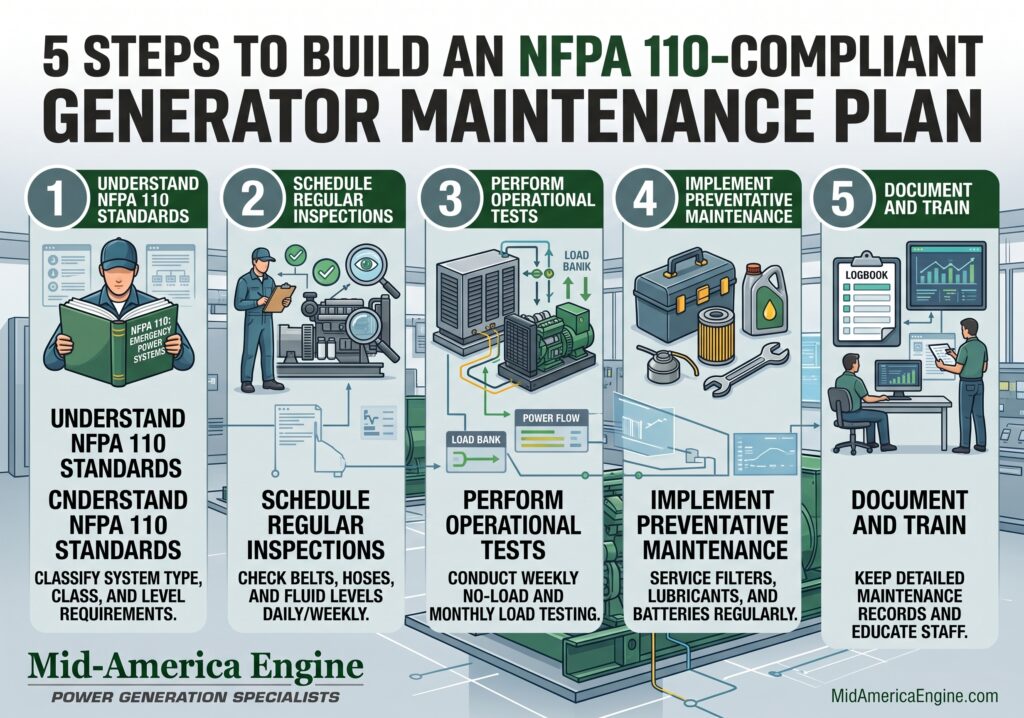
The following five steps provide a practical framework for building a defensible generator maintenance program. Confirm current NFPA 110 provisions, manufacturer instructions, AHJ requirements, and facility policy before finalizing your schedule.
1. Define the Requirements and Equipment Scope
Start by identifying exactly what the maintenance plan must cover. The generator set is only one part of the EPSS. A failure in the fuel system, automatic transfer switch (ATS), battery charger, exhaust, ventilation, or distribution equipment can prevent emergency power from reaching critical loads.
Review the following before assigning inspection intervals:
- EPSS classification and level
- Generator fuel type, rating, and application
- Engine, alternator, controller, and cooling system
- Main and remote fuel tanks, day tanks, pumps, and filters
- Starting batteries, chargers, and cables
- Automatic and manual transfer switches
- Emergency distribution equipment and circuit protection
- Exhaust, ventilation, and combustion-air systems
- Remote monitoring, alarms, and communication systems
- Critical loads and required operating duration
- Manufacturer service manuals and maintenance bulletins
- AHJ, insurance, accreditation, and facility requirements
Healthcare facilities may also face additional requirements from CMS, state regulators, accreditation organizations, or hospital policy. Data centers, industrial plants, and other mission-critical operations may have their own uptime, testing, and documentation standards.
A complete asset register is essential. Record each generator’s:
- Make, model, serial number, and year
- Prime and standby ratings
- Voltage, phase, and frequency
- Fuel type and storage capacity
- Engine hours
- Controller and ATS information
- Battery installation date
- Maintenance history
- Open deficiencies and corrective actions
This information prevents a common mistake: applying the same schedule to every unit regardless of age, duty cycle, fuel type, or application.
2. Establish Inspection and Exercise Intervals
Once the equipment scope is clear, create a written schedule that assigns responsibilities and due dates. A schedule should identify who performs each task, what readings are recorded, which conditions require escalation, and how failed tests are handled.
A commonly used NFPA 110-aligned baseline includes:
Weekly inspections
At intervals not exceeding seven days, inspect the EPSS for visible conditions that could affect readiness. Typical checks include:
- Fuel level and visible signs of leakage
- Oil level and signs of fluid loss
- Coolant level and block heater operation
- Battery condition, terminals, and charger status
- Control panel status and active alarms
- Generator operating mode, including AUTO readiness
- Belts, hoses, wiring, and connections
- Exhaust system condition
- Ventilation and louvers
- Unusual noise, vibration, odor, or damage
Monthly exercise
Exercise the generator under load at least monthly, subject to current NFPA 110 provisions, manufacturer requirements, and AHJ direction. Many maintenance programs use a minimum 30-minute loaded exercise, with diesel units generally operated at a sufficient load to support proper engine performance and help reduce wet stacking.
The exercise should evaluate the complete system: not simply confirm that the engine runs. Include the generator, ATS, controls, emergency distribution, alarms, and return-to-normal operation.
Healthcare facilities may need to meet additional timing requirements, including 12 loaded tests annually with intervals determined by applicable regulations. Confirm these requirements with the facility’s compliance team and AHJ.
Annual service
Annual maintenance commonly includes:
- Oil and filter replacement
- Fuel filter inspection or replacement
- Coolant testing
- Battery testing
- Belt and hose inspection
- Air filter inspection
- Exhaust and ventilation inspection
- Electrical connection inspection
- Control system review
- Fuel sampling and quality testing
- Review of operating data and recurring alarms
Operating hours, environmental conditions, load profile, and manufacturer instructions may require more frequent service.
3. Manage Fuel and Batteries Before They Become Failure Points
Fuel and starting batteries are two of the most common causes of generator failure. Both require routine inspection, testing, and documented replacement planning.
Fuel system management
Diesel fuel can degrade, accumulate water, or develop microbial contamination during storage. Natural gas systems require verification of supply pressure, regulators, valves, and related components.
Your plan should address:
- Fuel level and required operating duration
- Tank, piping, and day-tank inspections
- Water accumulation and sediment
- Fuel filter condition
- Transfer pump operation
- Fuel sampling and testing
- Fuel polishing or tank cleaning when needed
- Gas pressure and supply verification for natural gas units
- Emergency refueling procedures and vendor contacts
Fuel quality testing should follow the manufacturer’s recommendations and applicable facility requirements. Do not assume that a full tank contains usable fuel.
Mid-America Engine’s generator fuel management guide provides additional practices for fuel storage, filtration, testing, and load management.
Battery system management
A generator cannot support critical loads if it cannot start. Inspect batteries and chargers routinely for:
- Corrosion, leakage, swelling, or physical damage
- Loose or damaged terminals
- Proper charger operation
- Cable condition and secure connections
- Electrolyte level where applicable
- Voltage and specific gravity readings when required
- Capacity or load-test results
- Installation date and expected replacement window
Battery replacement should be based on test results, manufacturer guidance, environmental conditions, and operating history: not an arbitrary calendar date alone. Record all readings and replace weak batteries before they compromise starting reliability.
4. Schedule Load-Bank Testing and Transfer-Switch Checks
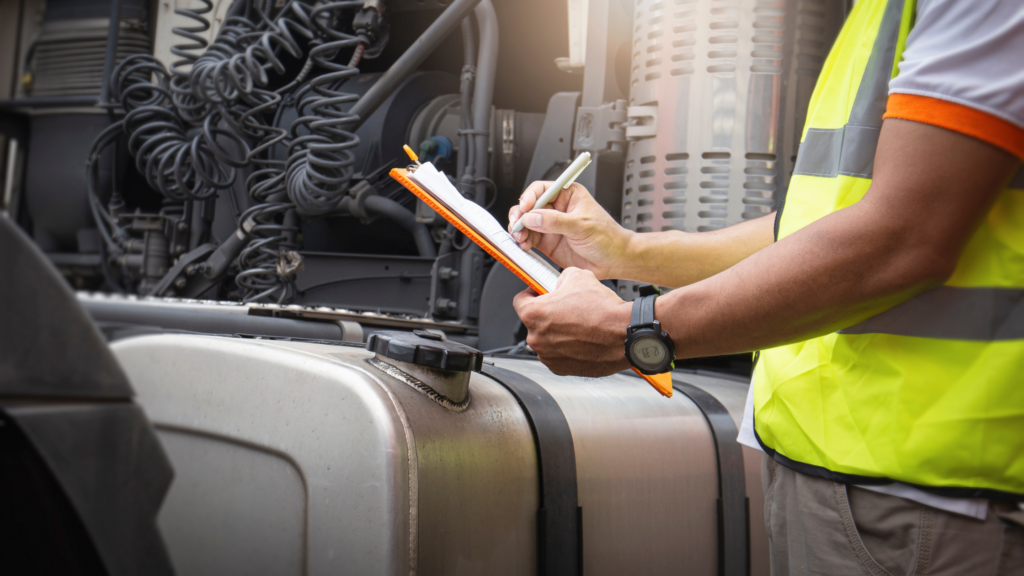
Routine no-load or lightly loaded operation does not prove that a generator can carry the facility’s emergency load. Load-bank testing applies a controlled electrical load so technicians can evaluate engine and alternator performance under operating conditions.
Load-bank testing can help identify:
- Insufficient capacity
- Voltage or frequency instability
- Cooling problems
- Fuel delivery restrictions
- Exhaust temperature concerns
- Alternator or connection issues
- Control and protection faults
- Performance problems that do not appear during light-load operation
The required test profile depends on the current standard, generator type, manufacturer instructions, facility classification, and AHJ expectations. Some programs use stepped annual testing with defined load and duration points. Level 1 systems may also require a longer-duration test at a defined interval, commonly every 36 months. Confirm the exact requirements before scheduling the test.
If normal facility loads do not reach the required level for routine testing, a load bank may be necessary to supplement the building load.
The ATS must be included in the maintenance plan. Transfer-switch checks should verify that the system:
- Detects a simulated or actual loss of normal power.
- Initiates the generator start sequence.
- Transfers emergency loads correctly.
- Maintains stable power during operation.
- Returns loads to normal power when appropriate.
- Re-cools and shuts down according to the programmed sequence.
- Records alarms, delays, and abnormal conditions.
Document start time, transfer time, voltage, frequency, load, alarms, and return-to-normal performance. A generator that runs correctly but fails to transfer power is not a reliable emergency power system.
Mid-America Engine provides load-bank testing and generator service to verify performance under real or simulated load conditions.
5. Document Corrective Actions and Maintain Emergency Support
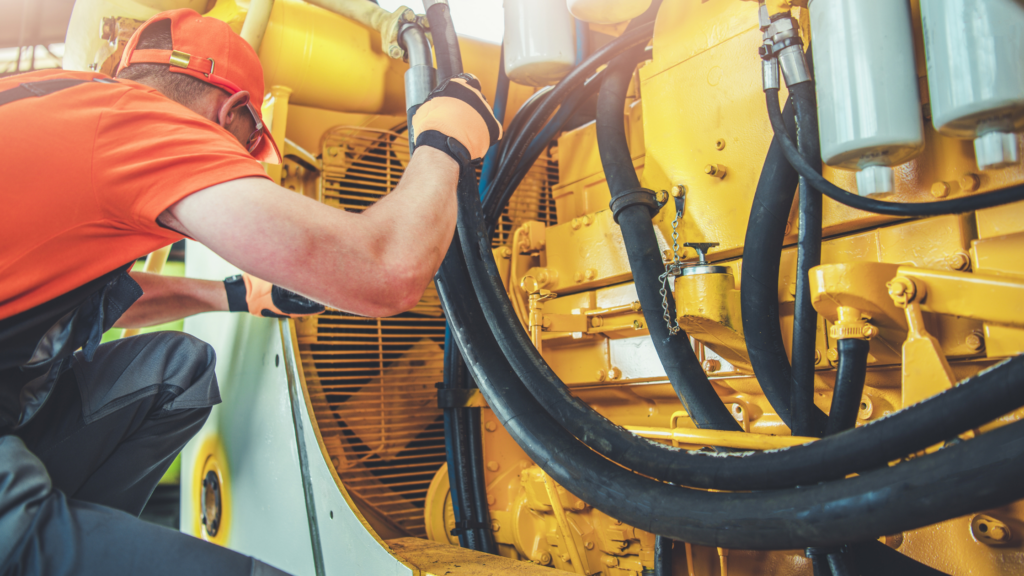
A maintenance plan is only effective when test results lead to action. Every inspection, exercise, service visit, load-bank test, and ATS operation should produce a clear record.
At minimum, document:
- Date and time of the activity
- Equipment identification
- Technician or responsible employee
- Operating hours
- Fuel level and system condition
- Battery readings
- Voltage, frequency, and load
- Start and transfer times
- Alarms or abnormal conditions
- Parts replaced
- Corrective actions recommended
- Person responsible for completion
- Target completion date
- Final verification and closeout
Use a risk-based priority system. A failed battery charger, fuel leak, ATS malfunction, or generator that will not start should receive immediate attention. Minor cosmetic issues can be scheduled differently, but they should not disappear from the record.
Maintain an emergency support plan with current contact information, equipment details, spare-parts requirements, access instructions, and escalation procedures. Operators should know what to do when the generator fails a test, displays a critical alarm, or does not return to AUTO.
Mid-America Engine offers generator maintenance, repair, troubleshooting, and emergency support for diesel and natural gas systems. With more than 40 years in industrial power, our team uses an engineering-driven approach to evaluate the system, identify the actual need, and provide honest recommendations: never overselling equipment or service.
Build a Plan That Holds Up Under Pressure
NFPA 110 compliance requires more than running a generator once a month. It requires a coordinated program covering the entire EPSS, from fuel quality and starting batteries to load testing, transfer switches, documentation, and corrective action.
Mid-America Engine can help you build and maintain that program with:
- Preventive maintenance service plans
- Load-bank testing
- Generator repair and troubleshooting
- Fuel-system support
- Transfer-switch checks
- Emergency response
- Engineering and system consulting
- Long-term maintenance guidance
When replacement or expansion is necessary, Mid-America Engine also has industrial diesel and natural gas generators and related equipment in stock and ready to ship. Our available inventory includes generator sets, engines, alternators, transfer switches, fuel tanks, radiators, enclosures, and other power-generation components.
Contact Mid-America Engine to review your current maintenance plan, schedule load-bank testing, or get immediate support for an industrial generator system.
Important: This article is provided for general planning purposes and does not replace the current NFPA 110 standard, manufacturer instructions, AHJ direction, applicable healthcare or regulatory requirements, or qualified service advice. Requirements vary by facility and system classification.