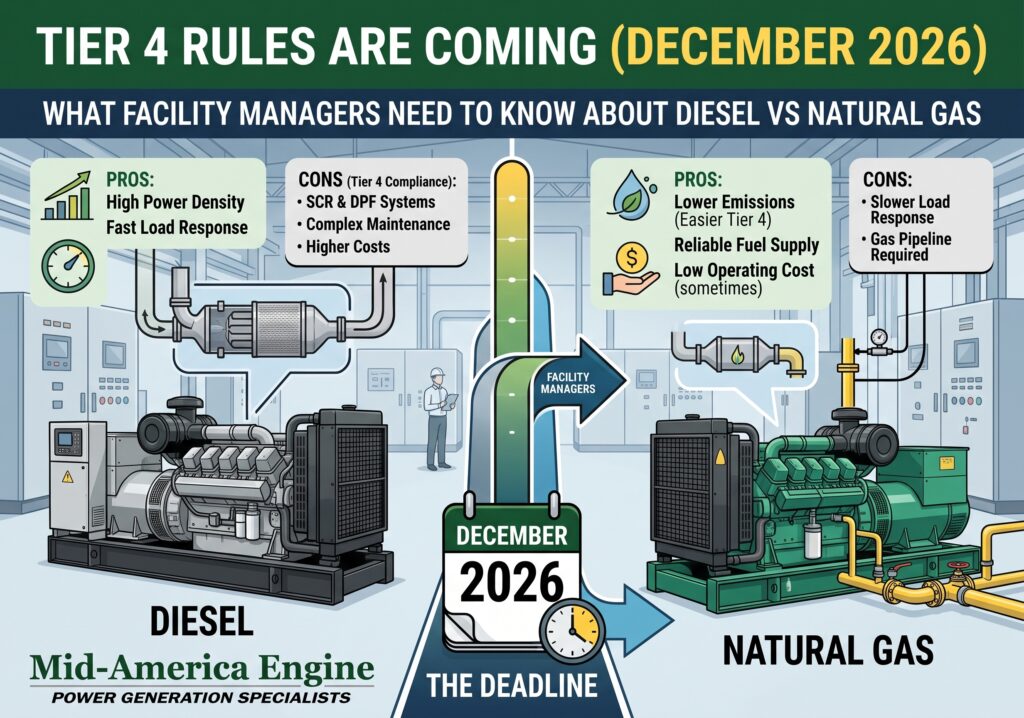
For Illinois data center operators, December 1, 2026, is a critical date for backup power planning.
Illinois Senate Bill 0025 changes the emissions standards that apply to many new or modified emergency generators at covered data centers. After the deadline, new air permit applications generally must specify diesel generators meeting EPA Tier 4-equivalent standards or natural gas generators meeting the applicable Tier 2 standard.
The change affects equipment selection, emissions documentation, project schedules, and procurement strategy. Facility managers who wait until after the deadline to evaluate their options may face longer lead times and fewer compliant configurations.
Mid-America Engine helps data centers and other critical facilities evaluate available industrial diesel generators, natural gas generators for sale, and complete standby power systems with an engineering-driven approach. We make honest recommendations based on the site: not on selling more equipment than necessary.
What Changes on December 1, 2026?
Under Illinois Senate Bill 0025, the new requirements apply primarily to covered data centers that require an Illinois EPA air pollution construction permit and operate under a Federally Enforceable State Operating Permit or Clean Air Act operating permit.
The key trigger is the date an air pollution construction permit application is submitted:
- Applications submitted before December 1, 2026 may not be subject to the new generator standards under SB 0025.
- Applications submitted on or after December 1, 2026 must generally specify compliant emissions configurations for new or modified emergency generators.
- The law applies to new or modified backup generators, not automatically to existing permitted equipment.
- Covered generators are intended for emergency, standby, maintenance, and readiness testing use: not economic dispatch or demand-response operation.
Facility managers should coordinate with their environmental consultant, permitting engineer, and generator supplier early. Equipment selection and permit strategy must align. Purchasing a generator first and reviewing emissions documentation later can create avoidable delays.
Diesel Compliance Requires More Than a Nameplate
Diesel remains a leading choice for backup power for data centers because of its fast load acceptance, high power density, and on-site fuel storage. However, post-deadline Illinois projects cannot assume that any diesel generator will satisfy the permit requirements.
EPA Tier 4 compliance may require advanced emissions hardware, depending on the engine family and rating:
- Selective catalytic reduction, or SCR
- Diesel particulate filters, or DPFs
- Diesel oxidation catalysts
- Exhaust gas recirculation
- Urea or diesel exhaust fluid systems
- Additional controls, sensors, and electronic monitoring
Some Tier 4-equivalent solutions use Tier 2 or Tier 3 engine platforms that have been retrofitted with approved after-treatment. The complete engine and emissions package: not simply the generator’s fuel type or model year: must be evaluated.
Facility managers should request:
- EPA emissions certification or certificate of conformity
- Engine family and model information
- Confirmation of the applicable emissions tier
- After-treatment specifications
- DEF storage and replenishment requirements, if applicable
- Installation, ventilation, exhaust, and maintenance requirements
- Documentation suitable for the Illinois EPA permit application
A diesel unit that is available immediately is not automatically a compliant unit for a post-December 1 permit. That distinction matters when evaluating used or surplus equipment.
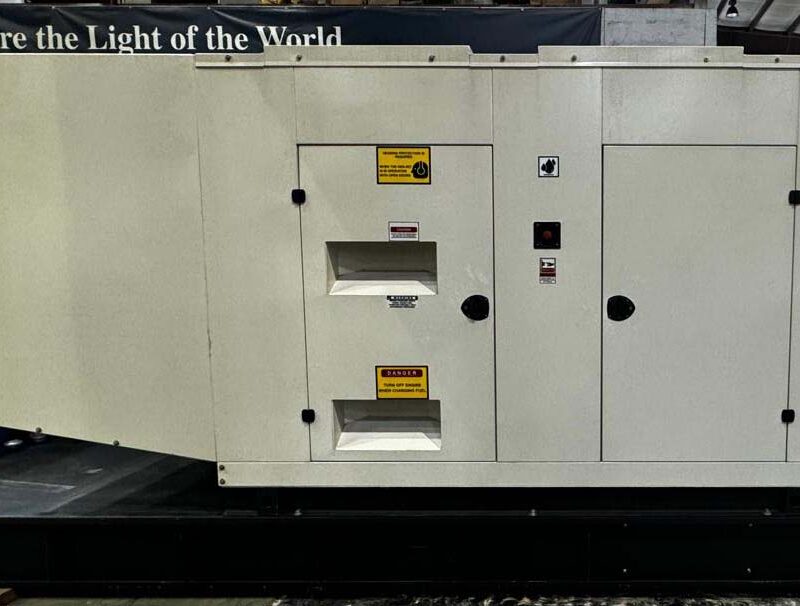
The 250 kW EPG 250P Perkins diesel generator is an example of the type of industrial diesel equipment facility managers may review for capacity, enclosure, fuel storage, and installation requirements. The listed unit is in stock, new, sound attenuated, three-phase, and mounted on a 500-gallon subbase fuel tank. However, its emissions certification must be verified for the specific Illinois project before it is selected for a covered data center application.
Why Natural Gas Deserves Serious Consideration
Natural gas generators offer a different compliance and operating profile. Natural gas combustion generally produces less particulate matter than diesel, and many natural gas engines can meet the applicable emissions standard without diesel-style SCR or DPF systems.
Under SB 0025, natural gas emergency generators are generally subject to the applicable EPA Tier 2 standard for large spark-ignition engines. That does not mean every natural gas genset is automatically approved. The engine certification, emissions data, operating conditions, and permit requirements still need to be confirmed.
Natural gas may be a practical fit when a facility has:
- Reliable utility gas service
- Adequate gas pressure and capacity
- A site layout where liquid fuel storage is difficult
- Extended outage concerns
- Strict local air-quality constraints
- A need to reduce particulate emissions and diesel after-treatment complexity
The tradeoffs also matter. Natural gas systems depend on the utility pipeline, which may be vulnerable during regional emergencies or supply interruptions. They may also have different transient-response characteristics and fuel-train requirements than diesel systems.
The right question is not whether diesel or natural gas is universally better. It is whether the fuel, generator rating, emissions package, utility infrastructure, runtime requirement, and permit strategy work together.
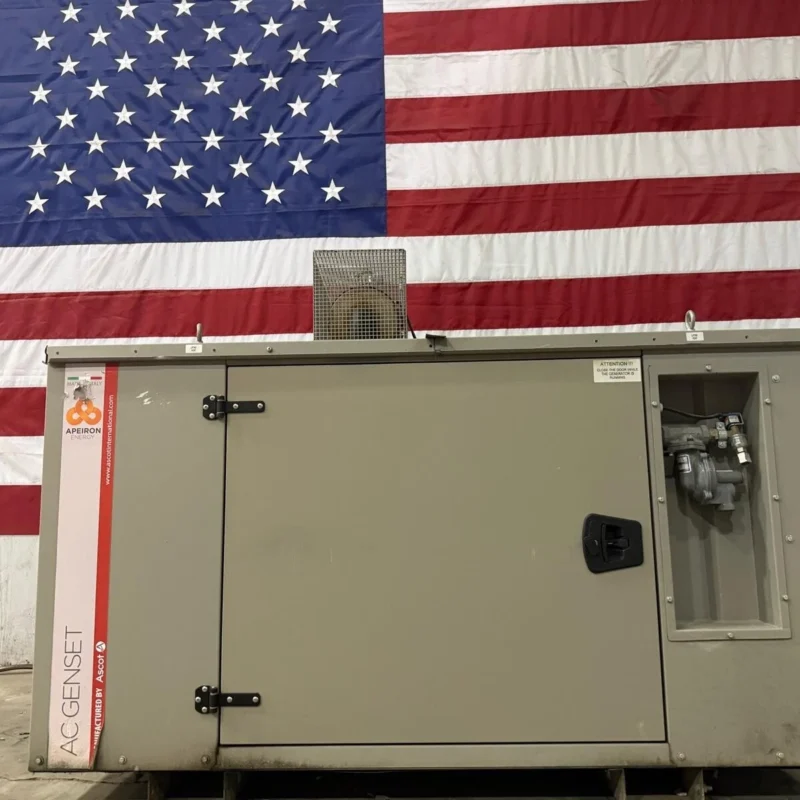
Mid-America Engine currently lists the 28 kW Ascot natural gas genset as in stock. The surplus-new unit has a weatherproof enclosure, Ford engine, Meccalte alternator, three-phase configuration, and only limited hours. It may be appropriate for specific auxiliary or smaller standby loads, subject to engineering review and emissions documentation.
Lead Times Make the Deadline More Important
Tier 4-configured new diesel generator sets can require longer production and delivery schedules. Additional after-treatment, controls, integration, testing, and emissions documentation can affect both procurement and installation.
That creates several schedule risks:
- The selected configuration may not be available from the manufacturer.
- SCR, DPF, or DEF components may have separate lead times.
- Larger enclosures and exhaust systems may require redesign.
- Permit reviewers may request additional emissions information.
- Factory testing and commissioning may move the delivery date.
- Electrical, fuel, exhaust, and controls work may not be ready when the generator arrives.
Ready-to-ship inventory can help reduce those risks. It does not eliminate the need for permitting or engineering review, but it can provide a faster starting point than ordering a new build after the market tightens.
The 60 kW Ascot natural gas genset is listed as in stock with a weatherproof enclosure, Ford engine, Meccalte alternator, and Deep Sea controls. For facilities with compatible gas service and properly sized loads, an available natural gas unit may offer a faster path to evaluation than waiting for a custom-configured diesel package.
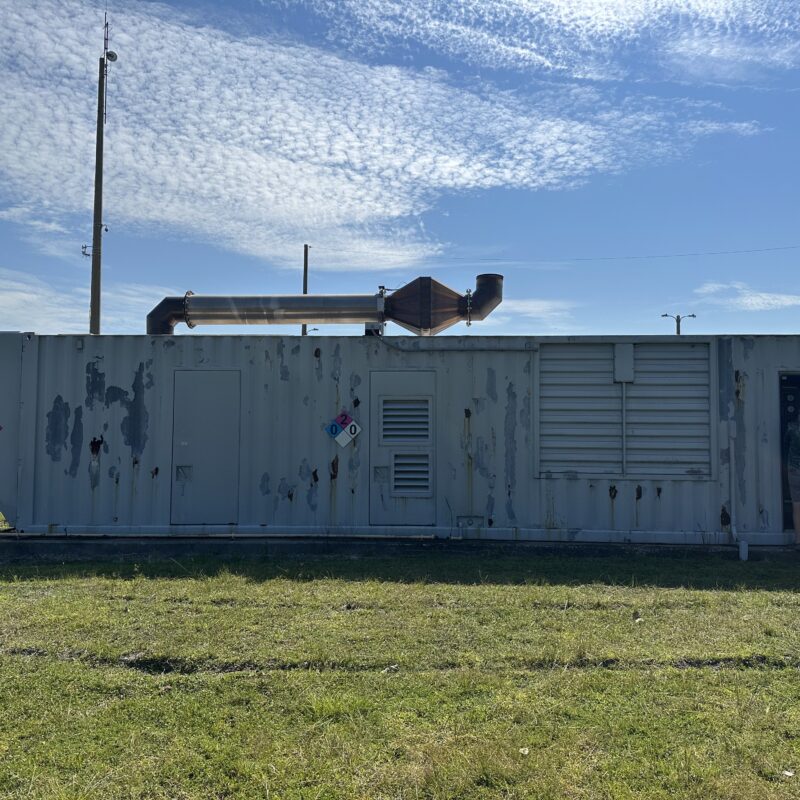
For larger requirements, the Cat Model 3516A 1600 kW generator illustrates the scale of equipment used for major industrial and data center applications. This listed unit is used, in stock, rated at 1,600 kW, configured for 277/480 volts, and has 2,197 hours. Its emissions status and suitability for a new Illinois permit would require detailed verification. Availability alone is not a substitute for certification.
A Practical Review Process for Facility Managers
Before selecting equipment, review the project in this order:
- Confirm permit applicability. Determine whether the data center requires a construction permit, FESOP, or CAAPP/Title V operating permit.
- Establish the permit application date. Applications submitted on or after December 1, 2026, face the new standards.
- Calculate the actual load. Review critical loads, motor starting, step-load acceptance, redundancy, and future expansion.
- Compare fuel infrastructure. Evaluate diesel storage, gas pressure, utility reliability, fuel delivery, and runtime requirements.
- Verify emissions certification. Obtain engine-family data and manufacturer documentation before committing to a unit.
- Review delivery timing. Compare ready-to-ship inventory against the schedule for a new Tier 4-configured unit.
- Plan the full installation. Include transfer switches, switchgear, exhaust, fuel systems, controls, sound attenuation, commissioning, and maintenance.
- Document the recommendation. Keep the equipment selection tied to load requirements, permitting, reliability, and lifecycle cost.
Mid-America Engine can support this process with equipment sourcing, engineering review, turnkey installation planning, maintenance, and rental options. Our goal is to identify the system that meets the application: not to oversell capacity or features.
The Bottom Line
Illinois SB 0025 makes December 1, 2026, an important planning deadline for new or modified data center emergency generators. Diesel remains a strong solution, but Tier 4-equivalent emissions hardware and certification must be addressed. Natural gas may simplify emissions control for some facilities, but utility reliability, engine certification, and site conditions still determine whether it is the right choice.
Reviewing available inventory now can create options that may not exist later. Browse Mid-America Engine’s generator sets inventory and contact the engineering team for an application-specific review.
Contact Mid-America Engine for an inventory review before the compliance deadline.
Frequently Asked Questions
Does SB 0025 apply to every generator in Illinois?
No. The law primarily affects new or modified emergency generators at covered data centers subject to applicable Illinois air permitting requirements. Existing permitted equipment is not automatically required to be replaced solely because of the December 1, 2026, date.
Is every diesel generator required to have SCR or a DPF?
Not necessarily. The required emissions configuration depends on the engine, rating, certification, and applicable permit standard. Some Tier 4-equivalent solutions use after-treatment such as SCR or DPF, while the specific package must be verified with the manufacturer and permitting team.
Are natural gas generators automatically compliant?
No. Natural gas engines generally have lower particulate emissions and may meet the applicable Tier 2 standard without diesel-style after-treatment, but compliance depends on the certified engine configuration and project requirements.
Can an in-stock generator be used for a data center project?
Possibly, but inventory status alone does not prove compliance. The generator’s emissions certification, engine family, rating, operating conditions, and permit applicability must be reviewed before purchase.
Should facility managers choose diesel or natural gas?
The answer depends on load profile, required runtime, utility gas reliability, fuel storage, emissions requirements, redundancy, site constraints, and schedule. An engineering-driven comparison is the most dependable way to avoid both under-sizing and unnecessary cost.