For commercial and industrial power projects, a generator lead time measured in months can become a serious operational risk. Manufacturing plants, hospitals, data centers, infrastructure projects, and large construction sites cannot always wait for an OEM production slot to open.
The “42-week” figure is increasingly used as a planning reference for certain industrial generator configurations. It is not a universal lead time. Actual delivery schedules vary by manufacturer, generator capacity, fuel type, emissions package, voltage, controls, enclosure, and current market conditions. Larger and more specialized systems may take substantially longer.
When the schedule is critical, a used, refurbished, surplus-new, or in-stock generator can provide a more practical path to energized power. The key is disciplined equipment selection and technical due diligence.
Long lead times create more than a procurement problem
A generator delay can affect the entire project schedule. Engineering reviews, electrical installation, commissioning, occupancy, production expansion, and contractual milestones may all depend on the equipment arriving on time.
The consequences of waiting can include:
- Delayed facility startup or expansion
- Extended rental equipment costs
- Rescheduled electrical and mechanical contractors
- Increased exposure to utility interruptions
- Delayed inspections and commissioning
- Expedited freight and installation premiums
- Lost production capacity or revenue
The generator itself is only one part of the timeline. Transfer switches, switchgear, fuel systems, enclosures, controls, permits, rigging, and site preparation must also be coordinated. A unit that is physically available can still require engineering and permitting before it can be placed into service.
Current industry reporting shows that new generator lead times vary widely, from several months to more than a year for larger or highly configured systems. Mid-America Engine’s guide to ready-to-ship industrial generators provides additional perspective on the difference between factory delivery and available inventory.
The practical advantage of used industrial generators
A used industrial generator is not automatically the right choice for every facility. However, when the priority is dependable power within a compressed schedule, it can offer important advantages.
Used generators can provide:
- Shorter delivery schedules: In-stock equipment can often move directly to inspection, freight, and installation instead of entering a factory queue.
- Lower capital cost: A properly evaluated used unit may cost considerably less than a comparable new system.
- Proven equipment history: Operating hours, maintenance records, and prior service documentation can help establish the unit’s condition.
- Established engine and alternator platforms: Popular models may have strong parts availability and broad technician familiarity.
- Configuration flexibility: Buyers can compare multiple available voltage, fuel, enclosure, and output combinations.
The trade-off is that the buyer must evaluate the equipment carefully. A lower purchase price does not compensate for an unsuitable emissions rating, unsupported controller, excessive wear, or a mismatch with the facility’s electrical system.
Compare all four equipment categories
“Used” is only one category in the industrial generator market. Buyers should understand the distinctions between used, refurbished, surplus-new, and new equipment.
Used generators
Used equipment has been placed in service and typically has an operating history. The most important questions concern:
- Total operating hours
- Maintenance and overhaul history
- Previous application and loading profile
- Storage conditions
- Engine and alternator condition
- Controller and switchgear compatibility
- Availability of test records
A used generator can be an excellent value when the records are complete and the unit passes appropriate testing.
Refurbished generators
Refurbished or remanufactured equipment has typically received corrective work intended to restore performance and serviceability. The scope can vary significantly between sellers, so request a written description of the work performed.
Clarify whether refurbishment included:
- Engine inspection or overhaul
- Gasket and seal replacement
- Cooling-system service
- Alternator testing
- Battery and charger replacement
- Controller updates
- Breaker or switchgear testing
- Cosmetic work only
Do not treat the word “refurbished” as a substitute for documentation. Ask for test results, replaced-part records, and warranty terms.
Surplus-new generators
Surplus-new units may have limited operating hours or only factory test hours. They can provide a useful middle ground between a factory order and traditional used equipment.
Verify:
- Date of manufacture
- Actual operating hours
- Whether the unit was ever commissioned
- Original documentation
- Emissions certification
- OEM warranty status
- Availability of replacement controls and parts
A surplus-new unit may be physically available, but it still must be compatible with the intended jurisdiction and application.
New OEM generators
New equipment generally provides the latest configuration, full or more comprehensive warranty coverage, and the strongest alignment with current emissions and controls requirements. It is often the preferred choice when the project requires a custom design or the latest technology.
The drawback is schedule. Manufacturing, component allocation, factory testing, transportation, and site commissioning can create a timeline that does not fit an urgent project.
Due diligence protects the schedule
Before purchasing any used, refurbished, or surplus-new generator, require documentation that supports the equipment’s condition and suitability.
1. Review hours and inspection records
Operating hours should be verified from the controller, hour meter, and available service records. Ask for:
- Engine and generator-set serial numbers
- Maintenance logs
- Oil and coolant analysis where appropriate
- Previous load profile
- Overhaul documentation
- Photos of data plates and control panels
- Records of stored or decommissioned periods
Low hours alone do not guarantee readiness. Equipment that has sat unused for extended periods may still require battery, fuel-system, cooling-system, or control inspection.
2. Require load-bank testing
A no-load start is not a performance test. Ask whether the generator has completed a load-bank test and request the report.
The documentation should identify, where applicable:
- Test duration
- Load percentage and load steps
- Voltage
- Frequency
- Amperage
- Oil pressure
- Coolant temperature
- Exhaust observations
- Alarms or shutdowns
- Final operating condition
A full-load test helps demonstrate that the engine, alternator, voltage regulator, cooling system, and controls operate together under demand. If testing has not been completed, establish who will perform it, when it will occur, and how failed results will be addressed.
3. Confirm emissions certification
Emissions compliance must be addressed before equipment is selected: not after it arrives at the site.
Confirm:
- Engine emissions tier
- Engine emissions label
- Intended use: emergency standby, prime, or continuous
- State and local air-permitting requirements
- Whether the unit can legally operate at the project location
- Requirements for exhaust after-treatment or monitoring
An older engine may be mechanically sound but unsuitable for the intended application or jurisdiction. Coordinate with the project engineer and permitting authority before committing to the equipment.
4. Match voltage, frequency, and electrical configuration
The generator must match the facility’s distribution system and load requirements. Review:
- Rated and standby kW
- Voltage
- Frequency
- Phase
- Number of leads
- Alternator model
- Power factor
- Paralleling requirements
- Motor-starting and transient-load requirements
- Short-circuit and breaker coordination
For example, Mid-America Engine’s in-stock Cat Model 3516A, 1600 kW generator is listed as a used diesel unit with 2,197 hours, 277/480-volt three-phase output, a Cat SR4 alternator, and a weatherproof enclosure. Those specifications are useful starting points, but the final selection must still be matched to the site design and operating requirements.
5. Verify controls and integration
Controls determine how the generator starts, transfers, communicates, alarms, and responds to load changes. Confirm the controller model and compatibility with:
- Automatic transfer switches
- Existing switchgear
- Building management systems
- SCADA or supervisory controls
- Data center monitoring platforms
- Remote annunciation
- Paralleling and synchronization systems
Controller availability is particularly important for older equipment. A generator may be mechanically supportable while its original control hardware is difficult to replace. Confirm firmware, communication protocols, wiring diagrams, and available replacement parts.
6. Plan parts and service support
Ask who will support the equipment after delivery. This may include the dealer, OEM, independent service provider, or a combination of those resources.
Review the availability of:
- Filters and routine service parts
- Belts, hoses, and cooling components
- Starters and alternators
- Sensors and actuators
- Engine components
- AVR and excitation components
- Controller hardware
- Breakers and protective devices
Mid-America Engine also maintains inventory beyond complete generator sets, including radiators, enclosures, fuel tanks, alternators, transformers, and switchgear.
A complete power solution includes the supporting equipment
A generator cannot protect a facility without the systems that connect it to the load. Depending on the installation, the project may require:
- Automatic transfer switches
- Distribution or paralleling switchgear
- Base tanks or day tanks
- Fuel polishing or transfer systems
- Radiators and cooling equipment
- Weatherproof or sound-attenuated enclosures
- Exhaust components
- Battery chargers and starting systems
- Remote annunciators
- Protective relays and breakers
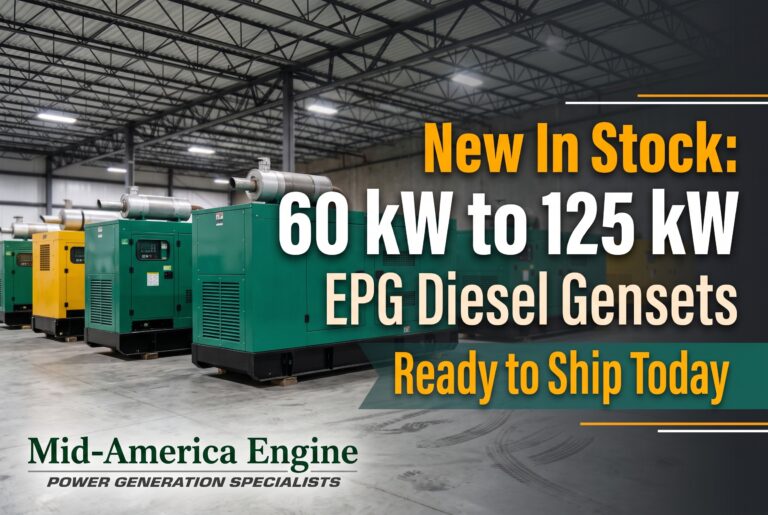
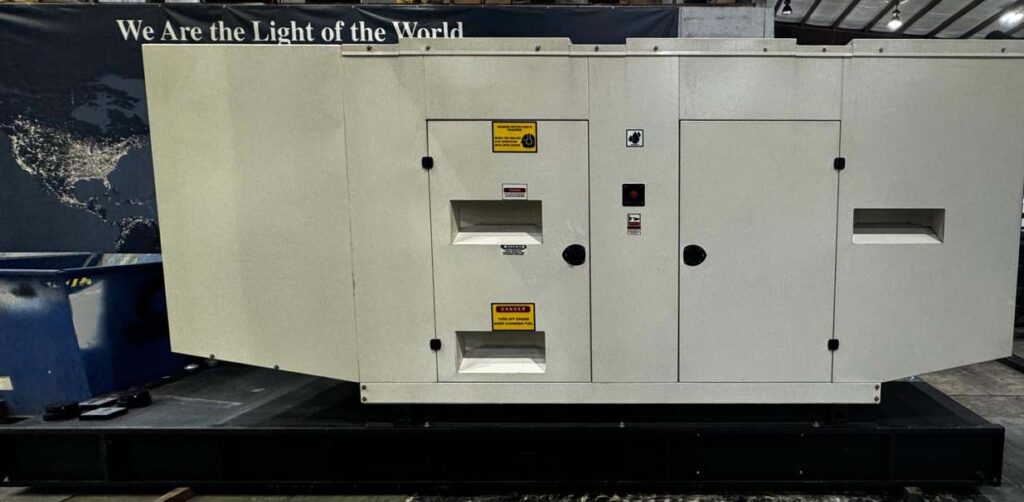
For example, an in-stock 250 kW EPG 250P diesel generator includes a Perkins engine, Stamford alternator, Deep Sea controls, sound-attenuated enclosure, and a subbase fuel tank. A complete configuration can simplify project planning, but voltage, fuel capacity, installation requirements, and permitting still need to be verified.
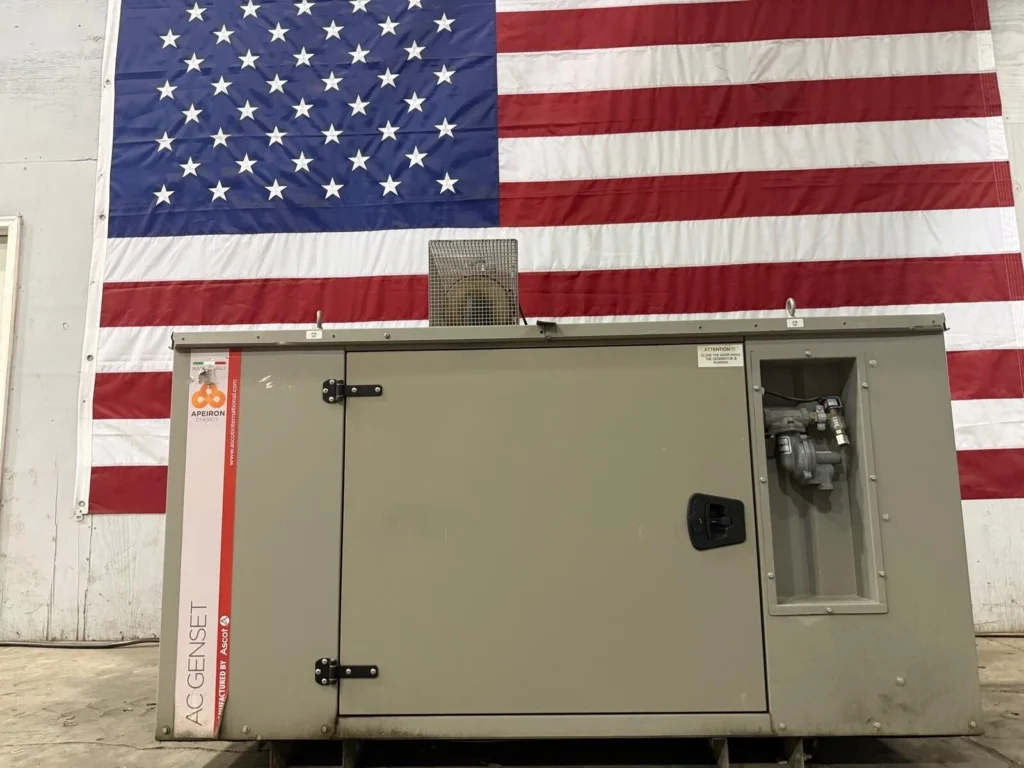
Natural gas equipment may also be appropriate where fuel infrastructure and emissions requirements support it. Mid-America Engine’s 28 kW Ascot natural gas genset is listed as surplus-new with a weatherproof enclosure, Deep Sea controls, voltage selector switch, and 50/60 Hz capability. The site utility, gas pressure, application, and local requirements must be reviewed before purchase.
Why Mid-America Engine is a practical partner
Mid-America Engine has more than 40 years of experience supplying industrial power equipment to organizations where downtime is not an option. Our generator-set inventory includes new, used, refurbished, and surplus-new diesel and natural gas units across a broad range of capacities.
Our approach is straightforward:
- Review the actual load and application
- Identify equipment that fits the technical requirements
- Confirm condition and available documentation
- Address controls, fuel, voltage, and installation requirements
- Provide honest recommendations without overselling
- Coordinate supporting equipment and logistics
- Help move the project toward commissioning
Availability changes quickly, and not every in-stock unit is the right fit for every facility. That is why engineering review matters.
Review available inventory before waiting 42 weeks
A 42-week lead time may be unavoidable for a specific new configuration. It should not automatically define the schedule for your entire project.
Review available used, refurbished, surplus-new, and new equipment first. The right in-stock generator may reduce procurement risk, control capital cost, and move your project from planning to installation far sooner.
Contact Mid-America Engine for an inventory review and freight quote. Provide your required kW, voltage, frequency, fuel type, location, application, and target delivery date. Our team can help identify available equipment, supporting components, and a practical path to dependable power.
Frequently asked questions
Are all industrial generator lead times 42 weeks?
No. Lead times vary by manufacturer, capacity, fuel type, emissions configuration, voltage, controls, enclosure, and market demand. Some standard units may be available sooner, while large or customized systems may require considerably longer.
Is a used industrial generator reliable?
A used generator can be reliable when its operating history is documented, its condition is verified, and it passes appropriate electrical and mechanical testing. Review hours, maintenance records, emissions documentation, controls, and load-bank results before purchase.
What is the difference between refurbished and surplus-new?
Refurbished equipment has generally received some level of corrective or restorative work after prior use. Surplus-new equipment is typically unused or minimally operated but may have been held in inventory outside the original factory delivery channel. Confirm the exact condition and warranty in writing.
Can an in-stock generator be shipped immediately?
In-stock equipment can usually move faster than a factory-ordered unit, but freight, rigging, permits, engineering, site preparation, and commissioning still affect the final schedule. Request a delivery plan and freight quote based on the actual job site.
What information should I provide when requesting a generator recommendation?
Provide the required kW, voltage, frequency, phase, fuel type, application, location, load profile, installation environment, emissions requirements, and desired delivery date. These details allow the equipment and supporting systems to be evaluated accurately.