For facility managers, hospital administrators, and data center operators, "backup power" isn't just a line item: it’s a non-negotiable insurance policy against catastrophic downtime. When the grid fails, the choice you made months or years ago regarding your fuel source determines exactly how long your operations stay online and how much that uptime costs you.
At Mid-America Engine, we’ve spent over 40 years helping organizations navigate this choice. We don’t believe in one-size-fits-all solutions. Instead, we take an engineering-driven approach to ensure you get the exact power system your facility requires: without being oversold on capacity or features you don’t need.
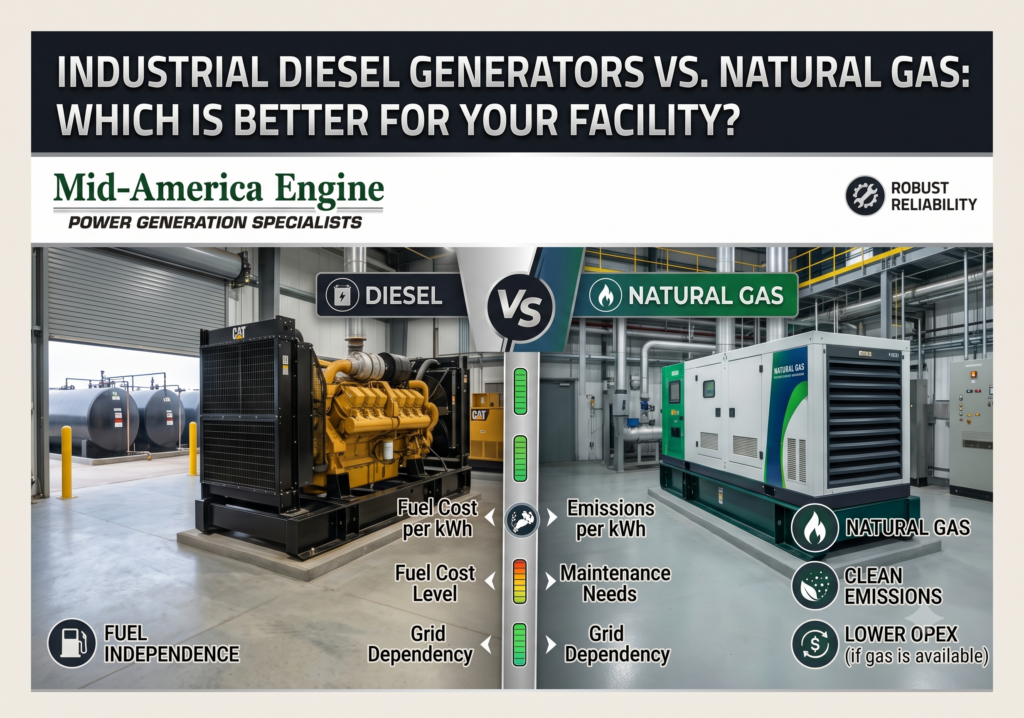
The debate between industrial diesel generators and natural gas units usually boils down to three factors: reliability, runtime, and total cost of ownership (TCO). This guide breaks down the technical specs and operational realities of both to help you decide which is the right fit for your facility.
The Case for Industrial Diesel Generators: The Gold Standard for Reliability
Diesel has long been the dominant choice for mission-critical applications, and for good reason. When speed and raw power are the priority, diesel is difficult to beat.
1. Superior Transient Performance
In a power failure, a emergency diesel generator must be able to pick up the entire facility's "dead load" in seconds. Diesel engines are designed for high "step-load" acceptance. This means they can handle the massive electrical surge of starting large chillers, elevators, or industrial motors without a significant drop in frequency or voltage.
2. On-Site Fuel Control
With a diesel system, you are the master of your own destiny. Because the fuel is stored in a sub-base tank or a large external tank on your property, you aren't dependent on underground infrastructure that could be compromised during a natural disaster, such as an earthquake or major freeze. For facilities where 100% uptime is mandatory, having 24 to 72 hours of diesel fuel physically present on-site is a significant security advantage.
3. Lower Upfront Capital Costs
Generally, diesel generators have a lower purchase price per kilowatt (kW) than natural gas units, especially as you move into the 500kW to 2MW+ range. If your primary goal is to secure the most reliable backup power for the lowest initial investment, brands like Caterpillar offer robust diesel options that are the industry standard for durability.
The Case for Natural Gas Generators: Sustainability and Long-Run Efficiency
While diesel is the traditional choice, natural gas technology has advanced significantly. It is now a highly viable: and often preferred: option for specific industrial use cases.
1. Virtually Unlimited Runtime
The most significant benefit of a natural gas generator is the fuel supply. Since these units are connected directly to the municipal gas utility pipeline, they can theoretically run indefinitely. You never have to worry about scheduling a fuel truck during a blizzard or a regional fuel shortage. This makes natural gas an excellent choice for areas prone to long-term outages.
2. Lower Operational Costs and Cleaner Emissions
Natural gas is consistently cheaper than diesel on a per-BTU basis. Furthermore, natural gas generators produce significantly fewer NOx and particulate emissions. If your facility is located in an area with strict air quality regulations or if your organization has aggressive ESG (Environmental, Social, and Governance) goals, natural gas is the clear winner. They also tend to run quieter and without the "wet stacking" issues or diesel odors that can plague liquid-fueled units.
3. Reduced Fuel Maintenance
Diesel fuel is an organic product that degrades over time. It requires "polishing," chemical stabilizers, and regular testing to ensure it doesn't clog injectors when you need it most. Natural gas doesn't spoil. This eliminates the need for expensive fuel maintenance programs, though the engine itself still requires regular service.
At-a-Glance Comparison: Diesel vs. Natural Gas
| Feature | Industrial Diesel | Natural Gas |
|---|---|---|
| Primary Use | Mission-critical / Life Safety | Long-duration / Continuous |
| Initial Cost | Lower (especially at high kW) | Higher (approx. 60–100% more) |
| Response Time | Fast (<10 seconds) | Slower (often >10 seconds) |
| Fuel Storage | On-site tanks required | Pipeline (utility) dependent |
| Maintenance | Fuel polishing & engine service | Spark plugs & engine service |
| Emissions | Higher (requires Tier 4 for some) | Lower (cleaner burning) |
| Lifespan | Extremely long (30+ years) | Moderate to long |
Critical Decision Factors for Facility Managers
Choosing between these two isn't just about the fuel; it’s about your specific operational constraints.
Siting and Footprint
Diesel units are typically more compact because the energy density of diesel is higher than natural gas. However, you must account for the space and weight of the fuel tank. For a 3-phase generator setup in a tight urban environment, the lack of a fuel tank might make natural gas more attractive, provided the gas line is already available.
The Cost of Overbuying
One of our core values at Mid-America Engine is that we never try to oversell you. Many facilities are pushed toward massive diesel units they don't actually need. We use an engineering-driven approach to look at your peak loads and transient requirements. Sometimes, a smaller, high-efficiency natural gas unit or a single-phase generator for non-critical loads is the more ethical and economical recommendation.
Regulatory and Code Compliance
In many jurisdictions, life-safety loads (like hospital operating rooms and emergency lighting) require on-site fuel storage by code (NFPA 110). In these cases, diesel is often mandatory unless you use an expensive on-site LPG (Propane) backup for a natural gas unit.
The "Hybrid" Middle Ground: Bi-Fuel Systems
If you want the reliability of diesel and the runtime of natural gas, a bi-fuel system might be the answer. These units start on 100% diesel but transition to a mixture of diesel and natural gas (often up to 70% gas) once they are under load. This extends your on-site fuel life significantly while maintaining the superior transient response of a diesel engine.
Why Experience Matters in Your Choice
With over 40 years in the industrial power industry, Mid-America Engine has seen every possible site configuration. We carry a massive inventory of both new and used units from top manufacturers like Cummins and Kohler.
Whether you need a full turnkey installation or are looking for a reliable used asset to fit a tight budget, our team provides honest, engineering-backed recommendations. We don't just sell you a box; we sell you a dependable power solution that ensures your facility never goes dark.
Ready to secure your facility's power?
Don't guess on your fuel source or your capacity. Contact Mid-America Engine today for a comprehensive site evaluation and an honest quote on the industrial generator that actually fits your needs.
Contact Mid-America Engine for an Engineering Consultation