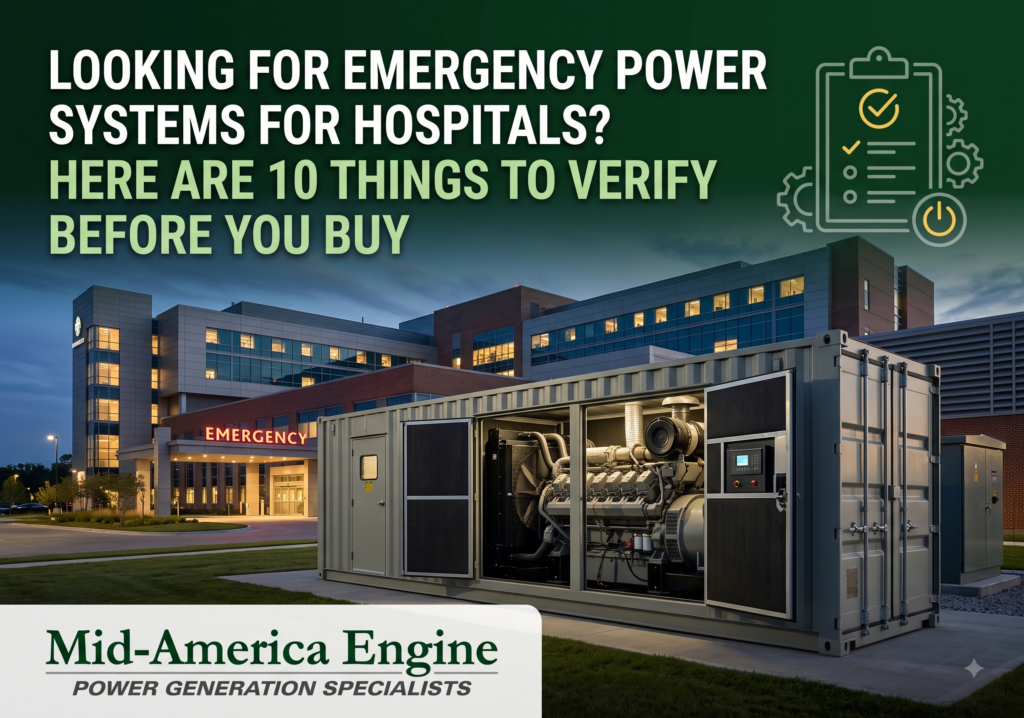
Hospitals cannot treat emergency power as a standard equipment purchase.
The system must support life safety, patient care, medical gas systems, communications, heating and cooling, information technology, and other essential loads when utility power is interrupted.
A generator with the correct nameplate rating is only one part of the solution. The complete emergency power supply system (EPSS) must be engineered, installed, tested, monitored, and maintained to perform when the facility needs it most.
Before approving a purchase, hospital administrators, facility managers, engineers, and healthcare operations teams should verify these 10 considerations.
1. Complete a critical-load analysis before sizing the generator
Generator sizing should begin with the hospital’s Essential Electrical System (EES), not with a preferred generator model.
Work with a qualified electrical engineer to identify the loads assigned to the:
- Life Safety Branch
- Critical Branch
- Equipment Branch
- Optional standby systems, where applicable
The analysis should account for both continuous operating load and transient demand. Large motors, chillers, air handlers, medical air compressors, vacuum pumps, elevators, and other inductive loads may create significant starting inrush.
The sizing review should evaluate:
- Total kW and kVA demand
- Voltage, phase, and frequency
- Largest motor-starting requirement
- Nonlinear loads and harmonic content
- UPS systems and sensitive electronic equipment
- Load-shed and load-add sequences
- Planned facility expansion
- Required reserve capacity
An oversized generator can create unnecessary capital and operating costs. An undersized generator can cause voltage instability, nuisance trips, failed motor starts, or loss of critical loads. Engineering-driven sizing protects both operational reliability and the project budget.
2. Verify the redundancy strategy
A hospital’s emergency power design should address more than a single utility outage. The system should also account for generator maintenance, equipment failure, fuel-system problems, and control-system faults.
Depending on the facility’s risk assessment and electrical design, redundancy may include:
- Multiple generator sets operating in parallel
- N+1 capacity
- Separate generator rooms or power paths
- Paralleling switchgear
- Independent utility sources
- Temporary generator connection provisions
- Load-shed controls that protect the highest-priority branches
The correct configuration depends on the facility’s EES, available space, required capacity, and adopted codes. The key question is straightforward: Can the hospital continue serving its highest-priority loads if one major component is unavailable?
Redundancy should be evaluated at the generator, fuel, transfer, control, and distribution levels: not just by counting generator sets.
3. Specify the right automatic transfer switches
Automatic transfer switches (ATS) initiate the generator start signal and transfer designated loads from the normal source to emergency power. They are central to system performance.
For hospital applications, verify that each ATS is properly rated and coordinated with the EES branch it serves. Important specifications may include:
- UL 1008 listing
- Automatic operation
- Voltage and frequency sensing
- Adjustable time delays
- Proper emergency-start signaling
- Open- or closed-transition operation
- Manual or automatic retransfer strategy
- Bypass-isolation capability
- Communications and alarm outputs
Bypass-isolation ATS equipment can allow inspection and service without interrupting connected loads, subject to the system design and operating procedure. Separate ATS arrangements are commonly used for the Life Safety, Critical, and Equipment Branches, although the final configuration must be determined by the engineer of record and authority having jurisdiction (AHJ).
Do not evaluate the generator without evaluating the transfer equipment. A correctly sized generator cannot compensate for an incorrectly specified or poorly coordinated ATS.
4. Confirm fuel supply and required runtime
Fuel planning must reflect the hospital’s emergency operations plan, local requirements, and expected outage conditions.
For diesel systems, review:
- Main tank capacity
- Day tank requirements
- Fuel polishing and filtration
- Water contamination controls
- Fuel delivery access
- Tank monitoring
- Fuel-quality testing
- Replenishment agreements
Many healthcare facilities plan for extended operation, often up to 96 hours, but the required duration can vary by jurisdiction, facility type, emergency plan, and AHJ direction.
Natural gas systems may offer a continuous utility fuel supply, but the engineering team should verify pipeline availability, pressure, utility priority during emergencies, seismic considerations, and any required secondary fuel or alternate power strategy.
Fuel capacity should be calculated from actual load expectations: not only from the generator’s maximum rating. Runtime estimates should also account for multiple units, load sequencing, fuel transfer equipment, and future operating conditions.
5. Review NFPA 110 and healthcare code requirements
Healthcare emergency power systems are subject to several overlapping standards and regulatory requirements. The design team should confirm the applicable editions and interpretations with the AHJ, accrediting organizations, and project engineer.
Relevant references may include:
- NFPA 110 : Standard for Emergency and Standby Power Systems
- NFPA 99 : Health Care Facilities Code
- NFPA 70 : National Electrical Code
- NFPA 101 : Life Safety Code
- Facility Guidelines Institute requirements
- CMS and accreditation requirements
- Local fire, building, electrical, air-quality, and fuel-storage regulations
For many hospital applications, Life Safety and Critical Branch loads must be restored within 10 seconds after normal power loss. Meeting that performance target requires coordination among generator starting time, voltage and frequency stabilization, ATS sensing, transfer delays, and load sequencing.
Codes establish minimum requirements. The final system should be designed around the hospital’s actual patient-care risk, operating procedures, and continuity objectives.
6. Confirm emissions requirements and permitting
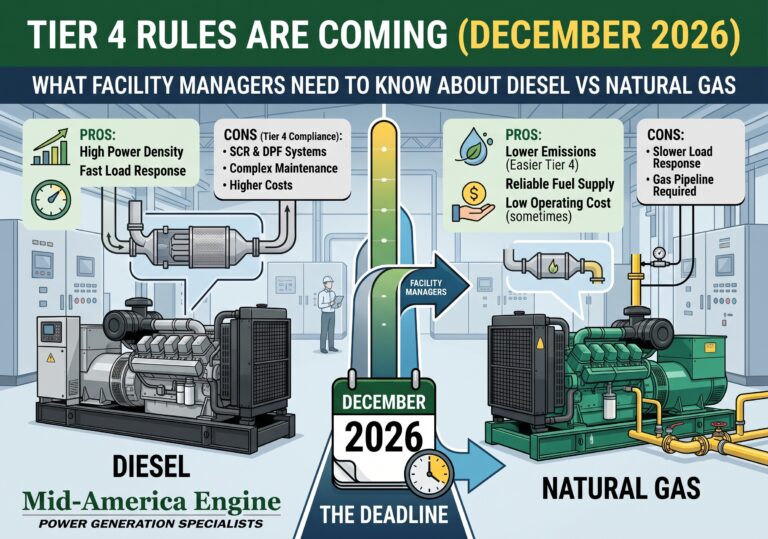
Generator emissions compliance can affect equipment selection, installation cost, schedule, and long-term operating flexibility.
Before purchasing, verify:
- Engine emissions tier
- Diesel particulate filter or selective catalytic reduction requirements
- Natural gas emissions profile
- Required operating permits
- Emergency-use limitations
- State and local air-quality rules
- Stack height and exhaust-dispersion requirements
- Recordkeeping and reporting obligations
Used equipment may offer a competitive acquisition cost and fast availability, but the engine’s year, emissions certification, rating, and previous operating history must be reviewed carefully.
A generator that cannot be permitted for the intended location is not a fast solution. Include the environmental consultant, engineer, equipment supplier, and AHJ early in the process.
7. Evaluate physical installation requirements
The generator must fit the site and remain serviceable after installation. Confirm the requirements for:
- Concrete foundation and structural loading
- Equipment access and rigging
- Generator-room ventilation
- Combustion-air supply
- Radiator discharge
- Exhaust routing and backpressure
- Fuel piping and tank location
- Electrical raceways and cable routing
- Weather or sound-attenuated enclosures
- Fire separation and clearances
- Flood, snow, wind, and seismic conditions
- Maintenance access around all major components
Installation planning should also account for noise, vibration, heat rejection, and proximity to patient-care areas or neighboring properties.
A turnkey approach can reduce coordination gaps between equipment, fuel systems, electrical distribution, controls, and commissioning. It also gives the facility one accountable partner for the complete installation scope.
8. Specify remote monitoring and control capabilities
Facility teams need clear visibility into the emergency power system before, during, and after an event. Monitoring should provide actionable information: not just a basic run indication.
Consider monitoring for:
- Generator status
- Voltage, frequency, kW, and kVA
- Oil pressure and coolant temperature
- Fuel level and fuel-system alarms
- Battery voltage and charger status
- ATS position and transfer time
- Common shutdown conditions
- Communication failures
- Maintenance due dates
- Generator exercise history
The controls should integrate appropriately with the facility’s building automation system, electrical power monitoring system, or central operations platform. Network architecture and cybersecurity should also be reviewed before connecting generator and ATS controls to operational technology networks.
Automated records can simplify compliance documentation and help the maintenance team identify developing problems before they become outages.
9. Require commissioning and load-bank testing
Commissioning establishes whether the installed system performs according to the design. It should include more than a basic engine start.
A thorough program may verify:
- Engine start and shutdown sequences
- Generator voltage and frequency
- ATS transfer and retransfer
- Transfer time for priority branches
- Load-shed and load-add sequences
- Emergency-stop operation
- Alarm and annunciator functions
- Paralleling and synchronization
- Fuel transfer and low-level alarms
- Remote monitoring points
- Protective-device coordination
- Operation under representative load
Load-bank testing is especially important when the connected facility load is too low to exercise the generator adequately. Healthcare testing programs commonly include regular loaded exercises and periodic extended testing, with exact intervals and procedures based on current standards, manufacturer instructions, facility policy, and AHJ requirements.
Document every test, measured value, abnormal condition, and corrective action.
10. Plan long-term maintenance and emergency support
Emergency power equipment can sit idle for long periods and still be expected to start immediately. Preventive maintenance is what makes that expectation realistic.
A complete service program should cover:
- Scheduled engine inspections
- Oil, coolant, and filter service
- Battery and charger testing
- Radiator, belt, hose, and cooling-system inspections
- Exhaust-system inspections
- Fuel sampling, filtration, and tank maintenance
- ATS exercising and inspection
- Control-panel and alarm verification
- Load-bank testing
- Parts replacement planning
- Emergency response support
- Detailed service records
The service provider should understand both the generator and the surrounding system. Transfer switches, fuel tanks, radiators, enclosures, engines, controls, and distribution equipment all affect availability.
Choose an industrial power partner, not just a generator
Mid-America Engine has more than 40 years of experience supporting organizations where downtime is not an option. MAE provides an engineering-driven approach to equipment selection, turnkey installation, long-term maintenance, and emergency support.
MAE maintains available inventory of new and used industrial diesel and natural gas generators, including units that may be ready to ship quickly. The company also supplies related equipment such as:
- Transfer switches
- Fuel tanks
- Engines
- Radiators
- Enclosures
- Generator accessories and supporting components
Review the current Mid-America Engine inventory or learn more about natural gas generator options. MAE’s team can help evaluate the application, confirm equipment availability, and identify the supporting components required for a complete solution.
Do not overspend on equipment that does not improve your hospital’s reliability. Request a sizing review, turnkey solution, or quick quote from Mid-America Engine today.