When your facility's power goes out, the clock starts ticking. For hospitals, data centers, and manufacturing plants, that clock isn't just measuring time: it’s measuring lost revenue, compromised safety, and operational chaos. At Mid-America Engine, we’ve been in the power game for over 40 years. We’ve seen every type of failure imaginable, and the hard truth is that most of them were preventable.
A standby generator is an insurance policy. But like any insurance policy, it only works if the "premiums" are paid in the form of regular, professional maintenance. Too many facility managers treat their generators as "set it and forget it" assets, only to realize their mistake when the lights flicker and the engine stays silent.
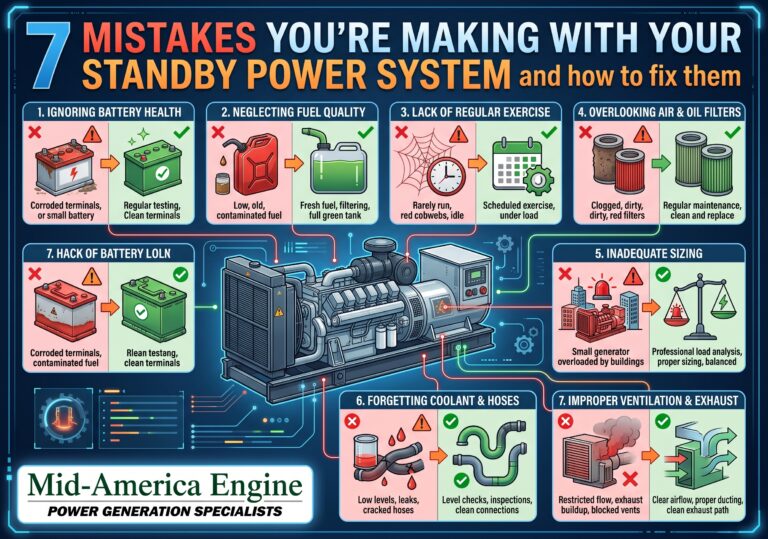
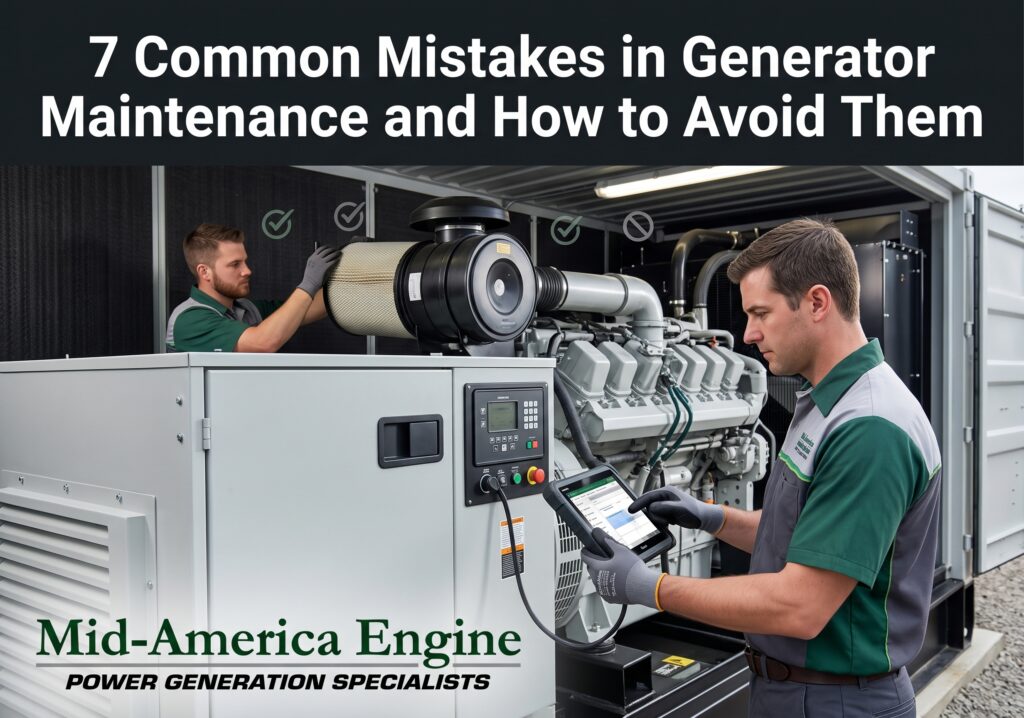
To help you ensure 100% uptime, we’ve identified the seven most common generator maintenance mistakes and, more importantly, how to avoid them.
1. The "Set It and Forget It" Fallacy
The most dangerous assumption a business owner can make is that a generator doesn't need service because it rarely runs. In reality, inactivity is an enemy of mechanical systems. Seals dry out, fluids settle, and components can seize.
Skipping scheduled inspections means you’re operating on hope rather than data. Regular generator maintenance services are essential to catch small issues: like a worn belt or a pinhole leak: before they turn into catastrophic failures during a storm.
How to avoid it: Treat your generator like a high-performance vehicle. Establish a strict maintenance schedule based on manufacturer recommendations and stick to it, regardless of how many hours the unit has run.
2. Battery Neglect: The #1 Cause of Failure
If you ask any experienced technician why a generator failed to start, the answer is almost always the battery. Batteries are the heart of the starting system, yet they are frequently neglected. They are prone to sulfation buildup, loose connections, and simple old age.

A battery might show enough voltage to power a control panel but lack the "cranking amps" necessary to turn over a massive diesel engine. Without regular testing, you’re essentially gambling on every start-up.
How to avoid it: Inspect your batteries monthly for corrosion and tight connections. More importantly, don't wait for them to die. We recommend replacing starting batteries every 36 to 48 months as part of a preventative care plan.
3. Fuel Degradation: Not All Fuel is Forever
Diesel fuel isn't like fine wine; it doesn't get better with age. Over time, diesel fuel undergoes a natural process of degradation. Condensation leads to water in the tank, which creates a breeding ground for microbes: often referred to as "fuel algae." This sludge clogs filters and can damage high-pressure fuel injectors.
How to avoid it:
- Fuel Testing: Have your fuel professionally sampled annually to check for water, sediment, and microbial growth.
- Fuel Polishing: If contamination is found, fuel polishing can clean the fuel without the need for expensive disposal and replacement.
- Stabilizers: Use high-quality fuel stabilizers to extend the shelf life of your stored diesel.

4. Skipping Load Bank Testing: The Ultimate Risk
Most generators run their weekly "exercise" cycle without a load. While this checks if the engine starts, it doesn't prove the generator can actually power your building. Skipping load bank testing is like training for a marathon by only walking to the mailbox.
Load bank testing uses a specialized piece of equipment to simulate the full electrical demand your generator is rated for. This tests the cooling system, the alternator, and the engine’s ability to handle the stress of a real-world outage.
How to avoid it: Schedule a load bank test at least once a year. It’s the only way to verify that your power system will perform at 100% capacity when it matters most.

5. Wet Stacking: The Diesel Engine's Enemy
When a diesel engine runs for extended periods under light loads (less than 30-50% of its capacity), it doesn't reach the operating temperatures required to burn fuel completely. This unburned fuel and carbon build up in the exhaust system, a condition known as "wet stacking."
Wet stacking reduces engine efficiency, increases emissions, and can eventually lead to permanent engine damage or even exhaust fires.
How to avoid it: Regular load bank testing is the cure for wet stacking. By running the engine at high temperatures for several hours, you burn off the accumulated carbon and "clean out" the system.
6. Neglecting the Cooling System and Fluids
A generator is a heat-generating beast. If the cooling system fails, the engine will shut down almost immediately to prevent a meltdown. We often see units where the coolant has become acidic, eating away at the radiator from the inside, or where belts have become brittle and snapped.
Similarly, oil is the lifeblood of the engine. Over time, oil breaks down and loses its lubricating properties, even if the generator hasn't been running.
How to avoid it:
- Check coolant levels and concentrations regularly.
- Perform oil and filter changes annually, or after a specific number of operating hours.
- Inspect hoses and belts for any signs of cracking or softening.
7. Poor Documentation and Regulatory Compliance
Maintenance isn't just about turning wrenches; it's about records. For many industries, especially healthcare and data centers, keeping detailed logs of maintenance and testing isn't just a good idea: it’s a legal requirement for compliance with organizations like the NFPA or JCAHO.
Failing to document your tests or missing a required inspection can lead to heavy fines, insurance complications, and a lack of accountability when something goes wrong.
How to avoid it: Maintain a dedicated maintenance log for each unit. Modern generator monitoring systems can automate much of this, providing digital records of every exercise cycle and alarm.
The Mid-America Engine Difference
At Mid-America Engine, we don't just sell equipment; we provide peace of mind. With over four decades of experience, our engineering-driven approach ensures that your power solution is tailored to your specific needs. We understand that in your world, downtime isn't an option.
Whether you need a one-time load bank test, a comprehensive preventative maintenance contract, or 24/7 emergency support, our team of experts is ready to help. We pride ourselves on honest recommendations: we’ll never try to sell you a service or a part you don’t actually need.
Ready to Protect Your Power?
Don't wait for the next power outage to find out if your maintenance plan is working. Contact Mid-America Engine today to discuss our professional generator maintenance services. From fuel polishing to turnkey installations, we have the inventory and the expertise to keep your facility running, no matter what.
Our Maintenance Offerings Include:
- Preventative Care: Customized schedules to keep your system in peak condition.
- Load Bank Testing: Full-capacity verification for ultimate reliability.
- Fuel Services: Testing, polishing, and stabilization.
- Emergency Support: Expert technicians available when you need us most.