A standby power system is only as reliable as its weakest component. A properly specified generator can still fail to protect a facility if the automatic transfer switch is mismatched, fuel storage is inadequate, ventilation is restricted, or commissioning is incomplete.
For hospitals, data centers, manufacturing plants, water treatment facilities, and large construction sites, the consequences of poor planning are serious. An outage can interrupt production, compromise safety systems, damage sensitive equipment, and create costly operational delays.
These are seven common standby power system mistakes: and the practical steps facility managers, plant engineers, contractors, and operations leaders can take to correct them.
1. Sizing the Generator From Average Load Only
One of the most common design errors is selecting a generator based only on the facility’s average running load. Average kW provides useful information, but it does not show what happens during an outage, when critical equipment starts or when multiple loads operate simultaneously.
A generator that appears adequate under normal conditions may be unable to support:
- Critical HVAC equipment
- Pumps and compressors
- Elevators and material-handling equipment
- Fire and life-safety systems
- Process equipment
- Data and communications systems
- Lighting and emergency distribution
- Battery chargers and UPS systems
Oversizing creates problems as well. A generator that operates continuously at a very low load may run inefficiently and experience wet stacking, carbon deposits, and poor fuel economy.
The fix: Complete a load study
Build the design around the facility’s actual operating requirements. Identify each critical load and document:
- Running kW and kVA
- Voltage and phase
- Power factor
- Duty cycle
- Starting method
- Required sequence of operation
- Future expansion requirements
Apply realistic diversity factors, then include an appropriate capacity margin. The result should support the required loads without paying for unnecessary capacity.
Mid-America Engine’s guide to sizing a commercial generator provides additional considerations for selecting the right equipment.
2. Ignoring Motor Starting and Transient Demand
A generator may carry a facility’s steady-state load and still fail during transfer because of motor starting demand. Large motors, pumps, compressors, air-handling units, and other inductive loads can draw several times their normal running current while starting.
That sudden demand can cause:
- Excessive voltage dip
- Frequency instability
- Motor stalling
- Nuisance trips
- PLC or control-system resets
- UPS incompatibility
- Contactors dropping out
- Failure of downstream equipment to restart
The automatic transfer sequence can make the problem worse if several motors start at the same time after utility power is lost.
The fix: Model the worst-case starting sequence
A complete engineering review should evaluate both running load and transient demand. Confirm the generator and alternator can handle the largest starting event while maintaining acceptable voltage and frequency performance.
Depending on the application, practical solutions may include:
- Staggered motor starts
- Time delays within the control sequence
- Variable-frequency drives
- Reduced-voltage starters
- Soft-start equipment
- Load-shedding controls
- Sequenced HVAC or pump operation
The goal is not simply to make the generator start. The goal is to restore essential operations without destabilizing the facility’s electrical system.
3. Mismatching the ATS and Voltage
The automatic transfer switch, or ATS, is the control point between the utility source, generator, and emergency distribution. If the ATS is not correctly matched to the generator and facility voltage, the system may not transfer safely or may fail to support the intended loads.
Common mismatches include:
- Incorrect system voltage
- Incorrect phase configuration
- Insufficient ampacity
- Incompatible frequency
- Improper neutral switching
- Inadequate short-circuit rating
- Incompatible control wiring
- Incorrect bypass-isolation arrangement
These issues are especially important in facilities with multiple voltage levels, separately derived systems, sensitive electronic loads, or complex emergency distribution.
The fix: Engineer the ATS as part of the system
Do not specify the generator first and treat the ATS as an accessory. Confirm that the generator, ATS, switchgear, distribution equipment, protective devices, and controls operate as one coordinated system.
Verify:
- Generator output voltage and frequency
- Phase rotation
- Continuous and emergency ampacity
- Utility and generator sensing requirements
- Transfer and retransfer timing
- Neutral and grounding configuration
- Compatibility with UPS and VFD equipment
- Required code and authority-having-jurisdiction requirements
Mid-America Engine supplies transfer switches and related power equipment to support complete standby power installations.
4. Underplanning Fuel Storage and Runtime
Fuel planning is frequently based on a simple nameplate estimate instead of the facility’s actual continuity requirements. That can leave a generator without sufficient runtime during a prolonged utility outage.
Fuel requirements depend on several variables, including:
- Generator rating
- Actual operating load
- Fuel type
- Site temperature and altitude
- Tank capacity
- Fuel delivery rate
- Fuel quality
- Refueling access
- Required outage duration
- Local storage and environmental requirements
Fuel lines can also be undersized or improperly configured. A system may start successfully but fail under load if the fuel supply cannot maintain the required flow.
The fix: Define the continuity target first
Determine how long the facility must operate without utility power. Then size the fuel storage, piping, day tank, pumps, filtration, containment, and delivery plan around that requirement.
The fuel system should also include a management plan. Diesel fuel quality can deteriorate during storage, allowing water, sediment, and microbial contamination to affect filters and engine performance.
A dependable plan should address:
- Fuel testing
- Tank inspection
- Water removal
- Filtration and polishing
- Fuel rotation
- Refueling during extended outages
- Emergency access for delivery vehicles
The generator is not an independent asset. It is part of a fuel system that must remain ready when the grid is unavailable.
5. Neglecting Ventilation and Exhaust
A generator room or enclosure must provide adequate combustion air, cooling airflow, and exhaust discharge. Treating ventilation and exhaust as late-stage mechanical details can result in forced derating, high engine temperatures, poor performance, and shutdowns under load.
Typical problems include:
- Undersized intake or discharge openings
- Recirculation of hot radiator air
- Restricted airflow through louvers
- Excessive exhaust backpressure
- Poor exhaust termination location
- Inadequate clearance around the radiator
- Limited access for service and inspection
- Failure to account for altitude and ambient temperature
Long exhaust runs and excessive bends can increase backpressure beyond the engine manufacturer’s limits. That can reduce performance and create additional stress on the engine and exhaust system.
The fix: Coordinate the installation early
Ventilation, exhaust routing, fuel systems, electrical distribution, structural requirements, and maintenance access should be reviewed together before installation begins.
The design should confirm:
- Combustion air requirements
- Radiator airflow
- Heat rejection
- Ambient temperature derating
- Exhaust pipe diameter and length
- Backpressure limits
- Discharge location
- Noise and emissions requirements
- Safe maintenance clearances
Mid-America Engine provides turnkey installation services covering pad, wiring, fuel, exhaust, and commissioning requirements.
6. Skipping Commissioning and Load-Bank Testing
Starting a generator and confirming that it produces voltage is not a complete commissioning process. A standby power system must be tested as an integrated system under realistic operating conditions.
Without thorough commissioning, problems may remain hidden until an actual outage:
- The ATS may fail to transfer correctly
- Motors may stall during startup
- Voltage recovery may be too slow
- Frequency may become unstable
- UPS systems may transfer to bypass
- Emergency circuits may not energize as intended
- Alarms may not reach the correct monitoring system
- Protective devices may trip unnecessarily
Simply running the generator at light load does not prove that it can perform when the facility needs full emergency capacity. Repeated low-load operation can also contribute to wet stacking and combustion deposits in diesel engines.
The fix: Test the complete operating sequence
Commissioning should verify the generator, ATS, controls, distribution equipment, and critical loads together. Depending on the facility, testing may include:
- Automatic start
- Utility failure simulation
- ATS transfer and retransfer
- Voltage and frequency recovery
- Motor starting
- Load sequencing
- Load shedding
- Alarm and annunciator operation
- Emergency shutdown functions
- UPS and sensitive-load compatibility
- Load-bank operation at an appropriate percentage of rated capacity
When facility load is insufficient, a properly sized portable or permanent load bank helps verify performance without placing unnecessary risk on production equipment.

7. Treating Maintenance as an Afterthought
A standby generator that is not maintained is not a reliable emergency asset. Even equipment that runs only a few hours each year requires scheduled inspection, testing, and service.
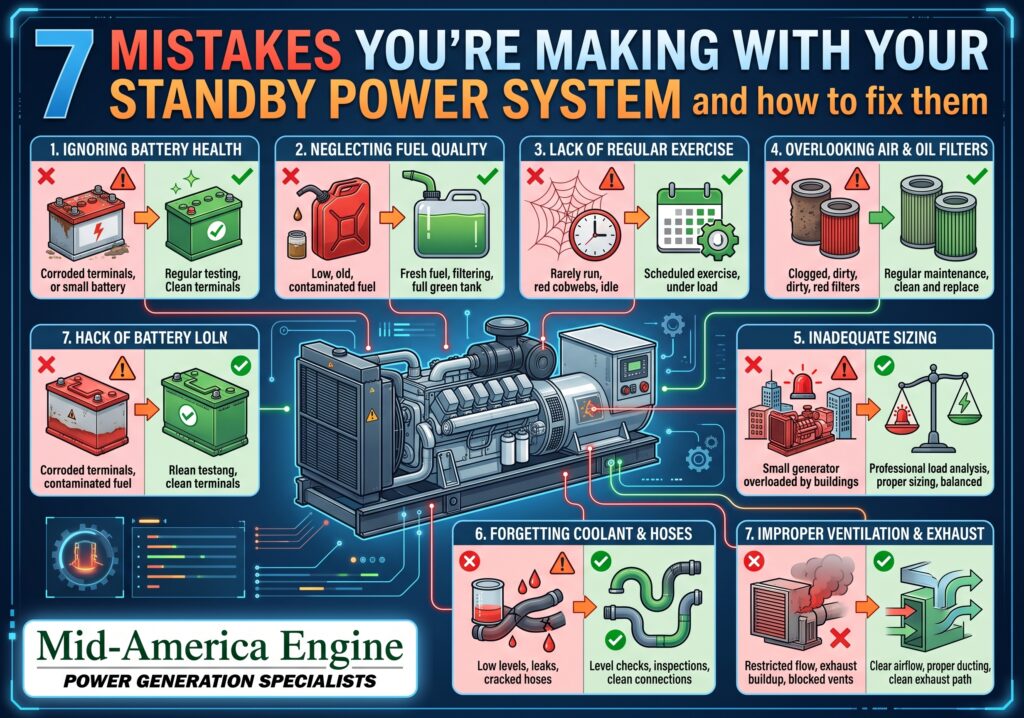
Common maintenance issues include:
- Weak or aging batteries
- Corroded battery connections
- Degraded coolant
- Clogged fuel or air filters
- Oil contamination
- Fuel contamination
- Loose electrical connections
- Faulty sensors
- Low coolant levels
- Control-panel alarms
- Deteriorated hoses and belts
- Exhaust leaks
Maintenance must cover more than the engine. The ATS, batteries, fuel system, starting system, controls, ventilation, exhaust, and emergency distribution all influence whether the facility receives usable power.
The fix: Establish a documented maintenance program
A dependable program should include:
- Scheduled visual inspections
- Battery testing and replacement planning
- Oil and coolant service
- Fuel quality testing
- ATS functional testing
- Control and alarm verification
- Infrared inspection of electrical connections
- Periodic load-bank testing
- Review of operating hours and fault history
- Written service records
Mid-America Engine provides generator maintenance services that include preventive care, load-bank testing, and emergency support. A structured service plan reduces surprise failures and gives operations teams a documented view of system readiness.
Engineer the Entire Standby Power System
Reliable standby power is not achieved by purchasing the largest generator available. It requires coordinated engineering from the first load calculation through long-term maintenance.
Mid-America Engine has more than 40 years of experience providing industrial power solutions for organizations where downtime is not an option. Our available generator inventory includes ready-to-ship new and used industrial diesel and natural gas generator systems, along with turbines, ORCs, transfer switches, engines, fuel tanks, alternators, enclosures, breakers, radiators, transformers, and other related equipment.
Our team takes an engineering-driven approach to every project:
- Honest recommendations based on actual requirements
- Fast lead times from available inventory
- Turnkey installation support
- Preventive maintenance and load-bank testing
- Emergency support when conditions change
- Solutions that are never oversold
Request an engineering review
If your standby power system has not been evaluated recently: or if you are planning a new installation: contact Mid-America Engine for an engineering review. We can help assess generator sizing, motor starting, ATS compatibility, fuel autonomy, ventilation, commissioning, and maintenance requirements before a preventable issue becomes an operational outage.