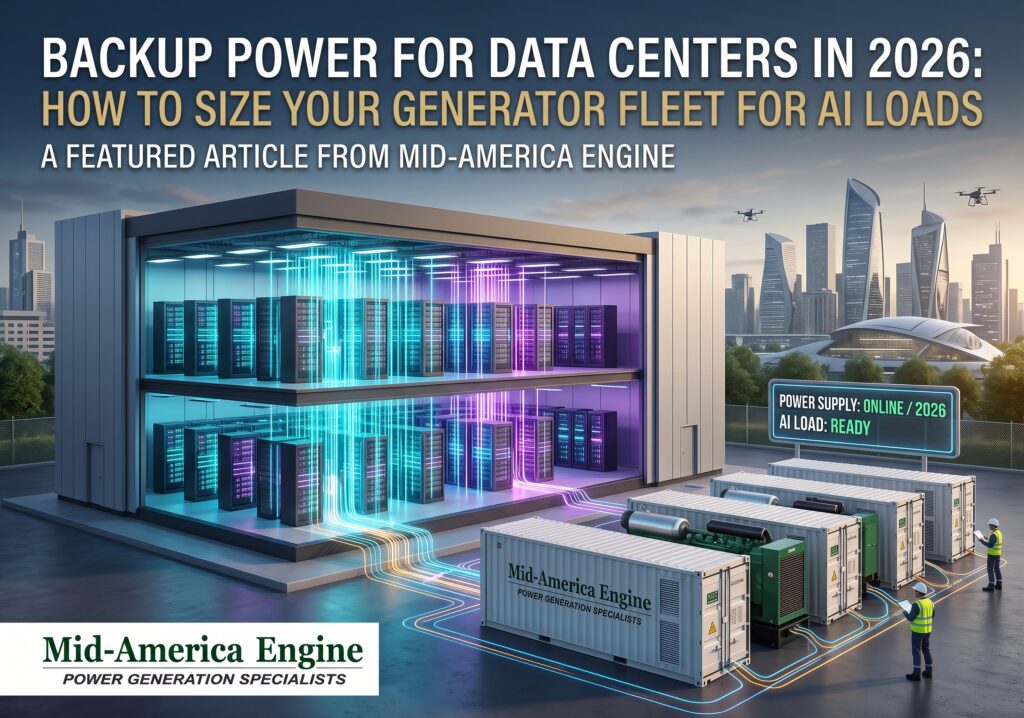
AI workloads are changing the electrical profile of modern data centers. Higher-density GPU racks, liquid-cooling systems, fast load changes, and phased campus expansion all affect how backup power should be designed.
A generator fleet that was adequate for conventional enterprise computing may not provide the transient performance, redundancy, or growth capacity required for an AI-focused facility. The correct solution depends on the site: not on a generic megawatt-per-rack rule.
Data-center owners, operators, facility managers, and electrical engineers should evaluate the complete power system, including:
- Measured IT load and projected growth
- Cooling and mechanical loads
- Generator ratings and derating
- Step-load and motor-starting performance
- Redundancy topology
- Fuel storage and runtime
- Paralleling switchgear and transfer equipment
- Controls, commissioning, and maintenance
Mid-America Engine has provided industrial power solutions for more than 40 years. Our engineering-driven team helps organizations select dependable new and used diesel and natural gas generators, related equipment, and turnkey installation services without overselling capacity or features that do not fit the application.
Start With the Entire Facility Load
The first sizing mistake is treating the IT load as the total generator requirement. In an AI data center, the generator plant may need to support servers, networking, cooling, pumps, controls, lighting, security, and other essential building systems.
A practical starting point is:
Total facility load = IT load × design PUE
Power Usage Effectiveness, or PUE, accounts for the energy required by cooling and other infrastructure outside the IT equipment. The design PUE must come from the facility’s actual cooling architecture, operating conditions, and engineering model.
For example, an illustrative facility with:
- 10 MW of measured IT load
- A design PUE of 1.35
would have an estimated total facility load of:
10 MW × 1.35 = 13.5 MW
That number is only a starting point. It does not yet account for generator derating, future expansion, motor starting, transient response, or redundancy.
AI Loads Require More Than Nameplate Capacity
AI systems can place unusual demands on an electrical distribution system. GPU servers may operate with substantial changes in demand as workloads shift between training, inference, data movement, and idle periods. Cooling demand can also change as rack power and thermal output increase.
The generator must remain stable during these events. Sizing should therefore evaluate:
- Continuous facility demand
- Expected load blocks and sequencing
- GPU and server power-supply characteristics
- UPS charging behavior
- Chiller, pump, and fan starting
- Harmonic content and power factor
- Voltage and frequency recovery
- Generator step-load acceptance
- Required load-transfer sequence
A large generator does not automatically provide adequate transient performance. The engine, alternator, excitation system, governor, controls, and distribution equipment must operate as one system.
Site conditions also reduce available output. Ambient temperature, altitude, enclosure configuration, exhaust design, cooling-air restrictions, and fuel type can all affect the final rating. Use the manufacturer’s site-rated data: not only the catalog rating: when calculating capacity.
Add Engineering Reserve for Growth and Transients
After calculating the total facility load, the design team should establish a documented reserve. This reserve is site-specific and should not be treated as a universal percentage.
It may need to cover:
- Near-term AI cluster additions
- Future building phases
- Chiller and pump starting
- Load-step events
- Environmental derating
- Equipment aging
- Operating restrictions
- Capacity unavailable during maintenance
For the illustrative 13.5 MW facility above, assume the engineering review establishes a 20% planning reserve:
13.5 MW × 1.20 = 16.2 MW of required capacity
That 20% figure is an example for explaining the process, not a recommendation for every facility. Some projects may require a different reserve, while others may use staged load addition, UPS support, battery energy storage, or additional controls to manage fast events.
Select the Redundancy Strategy Before Counting Generators
Generator quantity should follow the facility’s reliability requirements and electrical topology.
N capacity
An N configuration provides the capacity required to support the defined load. It does not include a spare unit for planned maintenance or an unexpected failure.
N+1 capacity
An N+1 configuration includes one additional generator beyond the number required to support the design load. The remaining units must still carry the required load if one generator is unavailable.
2N capacity
A 2N design provides two independent power paths, each capable of supporting the required load. This approach affects generators, paralleling switchgear, distribution, transfer equipment, controls, and fuel systems: not just the generator count.
Redundancy must also account for maintenance windows. A system that meets N+1 on paper may not meet the owner’s operating objective if multiple units must be offline for service, testing, or a controls upgrade.
Illustrative fleet example
Suppose the project requires 16.2 MW after applying the site-specific reserve. If the selected generator has a site-rated output of 1.6 MW:
- 11 units provide 17.6 MW of installed capacity.
- An N+1 arrangement would require 12 units so that 11 remain available if one unit is offline.
- A 2N arrangement would require two independent capacity blocks, each sized for the project’s defined load.
The actual fleet may look different after reviewing continuous versus standby ratings, site derating, step-load performance, physical layout, maintenance access, and available equipment.
Mid-America Engine maintains inventory that includes units such as the Cat Model 3516A, 1600 kW generator set. Availability changes, so confirm current condition, rating, controls, and delivery timing before basing a project schedule on a specific unit.
Choose the Correct Generator Rating
Standby, prime, and continuous ratings serve different operating profiles.
- Standby rating: Generally applies to emergency operation when the utility source fails.
- Prime rating: Applies to variable-load operation for extended periods under the manufacturer’s stated conditions.
- Continuous rating: Applies to constant-load operation for extended periods.
If the generators will operate only during utility outages, standby ratings may be appropriate. If they will provide bridge power while awaiting utility service, operate in parallel with the grid, support demand management, or serve as a primary power source, the engineering team must evaluate prime or continuous ratings.
Using a standby rating for a system that will operate regularly can produce an undersized design. Rating selection should also align with emissions permitting, operating hours, maintenance intervals, fuel consumption, and warranty requirements.
Match the Fuel Strategy to the Mission
Fuel planning is part of generator sizing. The correct choice depends on runtime objectives, site conditions, air permitting, utility reliability, fuel logistics, and whether the system is emergency-only or intended for regular operation.
Diesel generators
Industrial diesel generators remain a common choice for mission-critical backup because they provide on-site fuel control and strong load-acceptance performance. The design must include:
- Day tanks and bulk fuel tanks
- Fuel transfer pumps
- Filtration and fuel polishing
- Spill containment
- Venting and piping
- Fuel delivery access
- Runtime calculations at the expected load
Mid-America Engine offers industrial generator sets along with fuel tanks and related accessories.
Natural gas generators
Natural gas may support long-duration operation where pipeline capacity and resilience are suitable. However, pipeline pressure, utility interruption risk, gas availability during regional emergencies, emissions requirements, and engine transient performance must be verified.
A natural gas design should not assume that utility service will always remain available during a widespread event. Some facilities may require supplemental fuel, dual-fuel capability, or a separate emergency strategy.
Mid-America Engine supplies both new and used diesel and natural gas generator systems.
Engineer the Paralleling and Transfer System
Multi-generator data centers typically require paralleling switchgear and coordinated controls. The system must start, synchronize, load-share, unload, and isolate generator sets without creating unacceptable voltage or frequency disturbances.
The engineering review should address:
- Generator synchronization
- kW and kVAR load sharing
- Closed-transition or open-transition transfer
- Selective load shedding
- Bus sectionalizing
- Breaker coordination
- Short-circuit calculations
- Arc-flash considerations
- Manual bypass and maintenance operation
- Integration with the data center’s controls or SCADA platform
Transfer switches must match the facility’s distribution architecture and reliability objectives. A generator fleet cannot compensate for improperly specified transfer equipment, undersized feeders, or incomplete controls logic.
Account for Cooling and Mechanical Infrastructure
AI workloads increase the importance of cooling in the backup-power calculation. Depending on the design, the critical mechanical load may include:
- Chillers
- Cooling towers
- Computer room air handlers
- Pumps
- Fans
- Liquid-cooling distribution units
- Heat exchangers
- Controls and monitoring systems
Motor starting can create significant voltage and frequency demands. The preferred sequence may involve staged starting, soft starters, variable-frequency drives, UPS support, or battery energy storage. The generator alternator and excitation system should be evaluated against the actual starting profile.
Do not size the generator plant from server load alone. Confirm which cooling systems must remain online, which loads can be delayed, and how thermal conditions change during a utility outage.

Commission the System Under Real Conditions
A complete backup-power project is not finished when the generators arrive. Commissioning should verify the complete power path under controlled conditions.
A practical commissioning program may include:
- Factory and site acceptance testing
- Insulation and cable testing
- Protective-relay verification
- Controller and communications checks
- Automatic transfer testing
- Generator synchronization
- Load-bank testing
- Step-load testing
- Black-building or integrated systems testing
- Fuel-system verification
- Emergency-stop testing
- Alarm and annunciation checks
- Failure-mode and recovery testing
The facility team should receive clear operating procedures, one-line diagrams, maintenance schedules, and training before turnover.
Mid-America Engine provides turnkey installation and support, including pad, wiring, fuel, exhaust, commissioning, load-bank testing, and long-term maintenance coordination.
Maintain Capacity After Commissioning
AI facilities evolve quickly. Generator maintenance and capacity reviews should continue as IT loads, cooling systems, controls, and operating strategies change.
A dependable program should include:
- Preventive engine and alternator service
- Battery testing and replacement planning
- Fuel testing and polishing
- Cooling-system inspection
- Exercise testing
- Load-bank testing
- Controller and firmware review
- Transfer-switch maintenance
- Paralleling-switchgear inspection
- Exhaust and enclosure inspection
- Trend monitoring and fault review
Connected controls and remote monitoring can improve visibility, but they do not replace physical inspections and functional testing. Read more about generator fuel management and smart generator monitoring.
Get the Sizing Right Before You Buy
AI data-center power design requires more than adding generator nameplate capacity. The right fleet must support the actual facility load, withstand transient events, meet the selected redundancy strategy, operate within site conditions, and integrate with fuel, cooling, transfer, and controls infrastructure.
Mid-America Engine brings more than 40 years of industrial power experience, a large inventory of new and used diesel and natural gas generators, and an engineering-driven approach to every recommendation. We provide honest guidance, fast lead times, turnkey installation, and long-term support: without overselling equipment you do not need.
Request a data-center generator sizing review and quick quote. Share your measured IT load, design PUE, projected growth, site conditions, redundancy objective, fuel preference, and required delivery date. Our team will help evaluate the practical MW/MVA requirements and identify available equipment ready to ship.